A Fractional CTO is a chief technology officer who provides on-demand services to a company or organization. In other words, it is a freelance contract that implies working for a fraction of the time and cost and just on the part of the project as opposed to full- or part-time CTO positions.
This role can be performed remotely or on-site, depending on the company’s needs. Lately, however, a growing number of professionals are seeking remote positions exclusively because they enable greater flexibility that radically improves the work-life balance.
TL;DR
A Fractional CTO is a senior technology leader who supports a company part-time/on-demand—often remotely—to deliver executive-level outcomes without the cost and commitment of a full-time hire.
Fractional CTOs typically help with:
- Technology strategy + direction (what to build, why now, what to stop).
- Delivery systems (process, CI/CD, testing, operational hygiene).
- Product + engineering execution (roadmaps, resourcing, tradeoffs).
- Team building (hiring, onboarding/offboarding, structure, leadership).
- Scaling (platform readiness, org/process scaling, reliability).
Companies hire fractional CTOs because they need fast, credible leadership—often in a transition, growth moment, or leadership gap—while staying cost-effective (e.g., 15–20 hours/week instead of full-time).
To become one, you need a clear positioning (who you help + what outcomes you deliver), a repeatable engagement model (diagnose → plan → execute), and a pipeline (network, communities, targeted outreach, and the right job boards).
[Last updated: February 17, 2026]
Update (Feb 2026) includes: Added “owns/doesn’t own,” engagement models, red flags, success metrics, expanded FAQ, and refreshed US/UK rate benchmarks.
Table of Contents
What is the typical role and job description of a Fractional CTO?
In short, FCTOs are responsible for overseeing the organization’s tech strategy, direction, and operations. They help companies with tech-related tasks such as:
- Developing and implementing strategies
- Managing IT operations
- Overseeing product development
- Managing vendor relationships
- Evaluating and implementing new technologies
- Providing leadership and mentorship

As an FCTO, you are bringing your expertise and experience to help companies:
- Align their technological initiatives with their business goals and objectives
- Optimize investments
- Drive innovation
Scope clarity prevents disappointment on both sides. So it’s important to understand what fractional CTOs own and what not.
What a fractional CTO owns
- Technology direction: a clear, opinionated strategy tied to business goals (and a plan to execute it).
- Execution system: operating cadence, decision rights, priorities, and the mechanisms that make delivery predictable.
- Architecture guardrails: standards and tradeoffs that prevent expensive rewrites and keep scaling sane.
- Engineering leadership leverage: team structure, hiring bar, coaching, and accountability across tech delivery.
- Risk management: security, reliability, and technical debt triage, focused on what can actually hurt the business.
What a fractional CTO does not own
- Being your full-time CTO in disguise: if you need daily executive presence, you need a full-time leader.
- “Fix everything” with no authority: no decision rights = no accountability. Fractional leadership requires a sponsor who can commit and prioritize.
- Being the part-time senior engineer: occasional hands-on spikes are fine; permanent “hero coding” is not the model.
- Unbounded vendor/IT admin: tooling, procurement, device support, and helpdesk need clear ownership (unless explicitly scoped).
- Results without participation: the strategy only works when leadership and the team adopt the cadence, make tradeoffs, and follow through.
Common assignments of a Fractional CTO in day-to-day operations
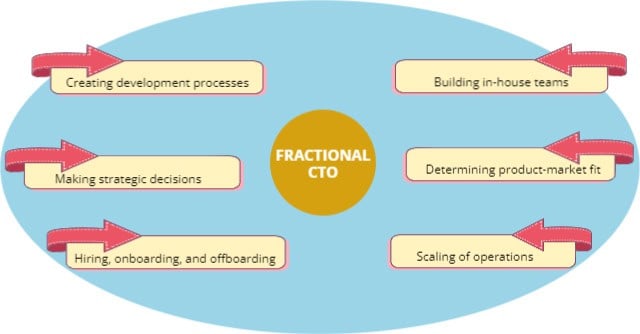
In our talks with tech leaders from all over the world these past few years, we have discovered that there are a few universal expectations from an FCTO:
- Creating development processes (i.e., CI/CD implementation, testing, etc.)
- Making strategic decisions
- Developing and supervising hiring, onboarding, and offboarding processes
- Building in-house teams during the company’s transition from the outsourcing model (common for startups)
- Discovering reliable and recurring revenue streams by determining product-market fit
- Enabling scaling of operations relevant to products and feature development
Observed from the outcome-first perspective, the list of assignments looks like this:
- Outcome: predictable delivery (less chaos, fewer surprises).
How: install an operating cadence, tighten planning, define “done,” introduce lightweight QA gates, and remove the top 1–2 bottlenecks slowing releases. - Outcome: faster decisions (less debate, more momentum).
How: clarify decision rights, set architecture guardrails, create a simple tradeoff framework, and align Product + Engineering on what matters this quarter. - Outcome: safer scaling (performance and reliability don’t collapse under growth).
How: stabilize the platform, add observability, harden incident response, reduce single points of failure, and prioritize technical debt that directly impacts uptime or velocity. - Outcome: a team that can execute without heroics.
How: reset roles and expectations, improve hiring loops, coach engineering leadership, fix incentives, and establish clear ownership across systems and domains. - Outcome: investor readiness (confidence during diligence).
How: produce a credible roadmap, quantify key risks, document architecture and security posture, define metrics, and create a technical narrative that leadership can defend. - Outcome: cost control without slowing down.
How: remove waste (unused tools, duplicated systems, inefficient workflows), right-size vendors, improve build vs buy decisions, and focus spend on the few bets that move outcomes.
Engagement models (how fractional CTOs typically work)
Most fractional CTO engagements fall into one of these three patterns:
- Assessment sprint (1–3 weeks)
A rapid diagnosis of the current reality: delivery health, team structure, architecture, risk, and priorities, all ending with a clear action plan and success metrics. - Operating retainer (monthly)
Ongoing executive leadership through a repeatable cadence: weekly sponsor sync, roadmap and delivery rhythm, decision-making guardrails, and continuous risk reduction. - Time-boxed execution (4–12+ weeks)
A focused mandate with a clear end state (e.g., stabilize releases, prepare for diligence, rebuild the team, modernize a critical system), often paired with hands-on workshops and heavier availability.
Rule of thumb:
Assessment → Retainer is the cleanest default. Use time-boxed execution when there’s a specific milestone or urgency driving the work.
Success metrics (what “good” looks like)
- Delivery becomes predictable: roadmap commitments start matching what actually ships.
- Lead time drops: work moves from idea → production faster, with less waiting and rework.
- Quality improves: fewer production incidents, fewer hotfixes, and cleaner release cycles.
- Decision-making speeds up: fewer stalled debates, clearer ownership, and better tradeoffs.
- Team health rises: lower burnout, clearer roles, stronger hiring signal, and better retention.
- Risk is under control: security and reliability gaps are visible, prioritized, and steadily reduced.
The two main external drivers of high demand for Fractional CTOs
Cost-effectiveness
Experienced chief technology officers may present a heavy burden on the usually limited startup budget. Additionally, the company may not yet have the need for a full-time CTO role.

In these circumstances, hiring someone to work only 15-20 hours a week can be a win-win situation for both parties. On the one hand, you can charge more per hour than possible in a permanent contract. On the other hand, the total cost for the company is less than it would be for a traditional position.
The remote and hybrid working trend
The paradigm has changed. Work is not necessarily where we go anymore, but what we do. That’s one of the reasons why remote/hybrid working is quickly becoming the model of choice for not only a growing number of companies of all sizes but also seasoned professionals.
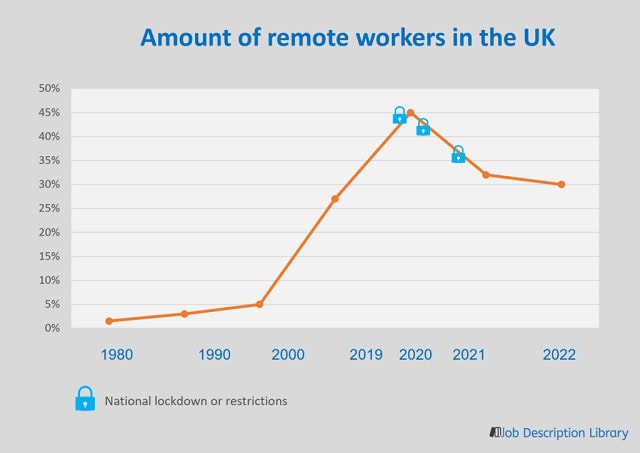
In such a scenario, organizations are removing geographical barriers and hiring talent from around the world at competitive prices. This, in turn, is allowing them to slice large projects into chunks and hire multiple fractional tech leaders to develop, oversee, and manage individual road maps.
Top reasons why companies are looking for fractional CTO services
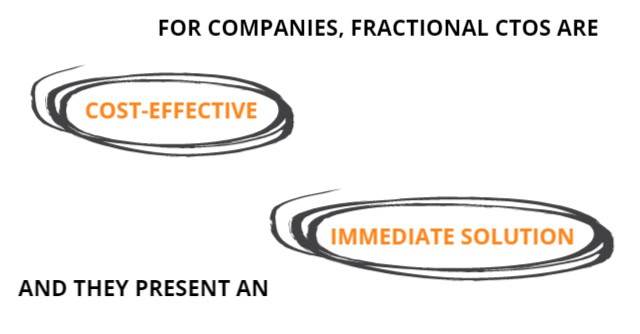
To put it bluntly, fractional CTOs are a) cost-effective, and b) represent immediate solutions for companies that require high-level tech management without the commitment and cost of an in-house employee.
This, basically, means that FCTOs are primarily engaged by SMBs that do not have the resources or need for a more permanent role but still require strategic technology leadership and guidance. Lately, however, we have also seen large companies offering this specific position.
Reasons companies opt for fractional CTOs
- The company is operating with a low budget and can’t afford to pay, for instance, a $250K/year salary.
- Time is of the essence, and they can’t afford to bother with the lengthy process of onboarding a full-time CTO; therefore, they are looking for someone who can start immediately.
- They are looking to hire more than one tech leader for any number of reasons; most commonly due to the sudden expansion after a successful funding round.
- They have the vision of a product but lack the practical knowledge to build such a technology. In such a scenario, you work closely with other C-suite executives to bring the product and tech strategy to life.
- They have serious issues with the technology team, either due to the unplanned departure of the previous leader or the team’s inefficiency caused, for example, by quiet quitting.
- They are changing the outsourcing model in favor of an in-house team of engineers.
- They need technical leadership to aid with raising funds from VCs, in which case, an FCTO is hired to review the architecture, development processes, disaster recovery, compliance policies, certifications, and other relevant parts of the operations and, ultimately, to ensure business continuity.
The difference between an Interim CTO and a Fractional CTO
An Interim CTO is a temporary or transitional tech leader. For example, one can be appointed when the current tech leader is on leave or when a role suddenly becomes vacant. Another instance would be a crisis or significant change.
ICTOs are typically engaged for a defined period. They are responsible for managing the following:
- The technology strategy
- Operations
- Team
The significant difference between the two is that an ICTO controls the helm while a fractional CTO is responsible for just one segment of navigation.
Additionally, an FCTO may operate on an ongoing basis while an ICTO is hired for a specific and relatively short period.
The average Fractional CTO rates and salary (refreshed for 2026)
“Fractional” pricing isn’t just a smaller version of a full-time CTO salary. It’s a premium for concentrated senior judgment—typically packaged as a monthly retainer (operating cadence + decision-making) and sometimes topped up with short, high-intensity bursts (assessment, turnaround, fundraising prep).
Below are the current market benchmarks for the US and the UK.
How to use these numbers (without getting misled)
- Use full-time salary to anchor “what dedicated ownership costs.”
- Use fractional rates to price “high-intensity leverage” (fast decisions, fewer mistakes, less risk).
- For most companies, a fractional CTO is best bought on a cadence + outcomes basis, not as “hours.”
| Market | Full-time CTO salary benchmark | Fractional pricing proxy |
|---|---|---|
| US | ~$309k average (Salary.com, Jan 1, 2026) | ~$200–$500/hr and ~$10k–$25k/mo retainers (market guides) |
| UK | ~£116.7k average (Glassdoor UK, Feb 2026) | ~£800/day median contractor rate (ITJobsWatch, 6 months to Feb 16, 2026) |
United States fCTO rates (US)
Full-time CTO salary (benchmark)
Think of this as the reference point for what “dedicated executive ownership” costs:
- ~$309k average CTO salary in the US (Salary.com, Jan 1, 2026).
- ~$318k average (Glassdoor, Feb 2026).
- PayScale shows a lower average (~$183k), which often reflects how loosely “CTO” gets used as a title in smaller firms.
Fractional CTO rates (what companies typically pay)
You’ll see two dominant patterns:
- Hourly (for diagnostics/architecture/due diligence): commonly $200–$500/hr, with premiums for urgent turnarounds, security/regulatory work, or “hands-on executive operator” mandates. Fractional CTOs in our community report an average of $300/hr.
- Retainers (for ongoing leadership): commonly mid-four to low-five figures per month, depending on scope, availability, and decision load.
What’s changing (2025 → 2026)
Buyers are getting sharper: they’ll pay for a fractional CTO who can install operating rhythm, reduce delivery risk, and make priorities stick, but they’re less interested in “advice-only” arrangements.
United Kingdom fCTO rates (UK)
Full-time CTO salary (benchmark)
UK CTO pay is highly sensitive to what the title actually means (true exec vs senior engineering lead), but current benchmarks cluster here:
- ~£116,658 average CTO salary (Glassdoor UK, Feb 2026).
- Many “salary guide” ranges for senior CTO roles typically span £120k–£200k+, depending on market and mandate.
- Survey-based estimates highlight a higher “senior end” in the ~£166k range for experienced CTO profiles.
Fractional/contract pricing (best UK proxy)
The UK market often expresses “fractional CTO” as a contract day rate:
- £600/day median for CTO contract roles (ITJobsWatch, based on postings in the 6 months leading up to 12 Feb 2026).
What’s changing (2025 → 2026)
Budgets are tighter for generic leadership, but the market still pays for fractional CTOs who can stabilize delivery, de-risk security, and get the company investor-ready on a clear timeline.
What drives variance (and why “average” can mislead)
Fractional CTO pricing moves fast based on:
- Stage + urgency: turnaround, missed deliveries, or funding deadlines cost more.
- Scope + decision rights: “advisor” is cheaper than “operator accountable for outcomes.”
- Risk profile: security, compliance, reliability, and platform scale add a premium.
- Hands-on depth: occasional spikes are normal; becoming the de facto lead engineer changes the model.
- Time commitment + availability: 5–10 hours/month ≠ 1–2 days/week.
PROs and CONs of the fractional tech leadership
As with every other contract type, there are advantages but also downsides to working as a fractional CTO.
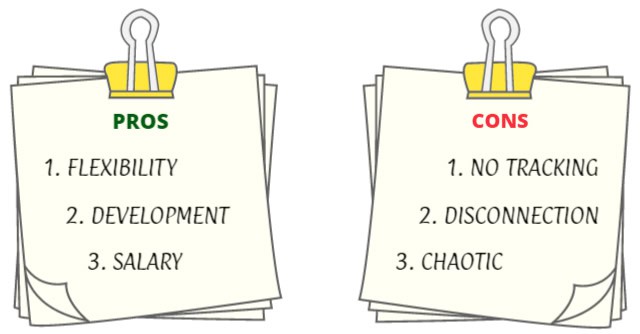
Pros
- Flexibility in terms of location and time.
- Working in different industries and sectors, thus, developing professionally at a much faster pace.
- Compensation can be much higher than in full-year positions.
Cons
- It’s hard to track the successes and end results of your work.
- Feeling disconnected from the company’s culture (i.e., a lone wolf syndrome).
- The pains of bringing order into chaos which is a common scenario in startups.
Where to find job opportunities
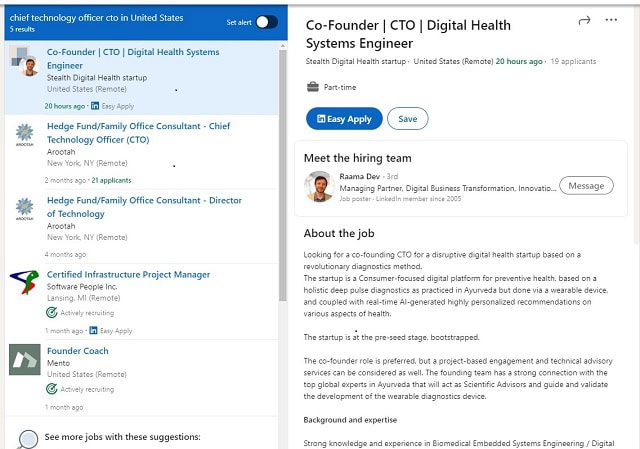
For those without a network, the quickest way to find fractional CTO jobs is through job boards like:
- Indeed (review Indeed’s available jobs)
- Glassdoor (review job positions on GD)
- LinkedIn (view relevant LI job search)
- Builtin (review and apply for fractional tech-lead jobs)
- Zippia (check current job opportunities on Zippia)
It is also wise to join CTO groups like ours here at the Academy and attend specialized events where you can participate in discussions and establish long-lasting relationships with your peers. In our experience, there is no better way to get a timely tip for a new job opening.
How to get hired
How to Become a Fractional CTO (a simple 3-step path)
1) Positioning: pick a lane
You don’t need to be “CTO for everyone.” You need to be the obvious choice for a specific situation.
- Choose who you help (stage, domain, team size, constraints).
- Choose what outcome you reliably deliver (stabilize delivery, scale platform, rebuild team, investor readiness).
- Build proof: 2–3 short case stories with measurable before/after signals.
2) Offer: make it easy to buy
Fractional leadership sells faster when it’s packaged as a repeatable engagement, not open-ended availability.
- Start with an assessment (rapid diagnosis + priority map).
- Turn that into a plan (tradeoffs, sequencing, ownership, success metrics).
- Run an operating cadence (weekly exec sync + delivery rhythm + decision log) that makes progress inevitable.
3) Pipeline: build a predictable deal flow
Most fractional CTO work is won through trust, not applications.
- Referrals and warm intros (founders, operators, investors, agencies).
- Community presence (where founders already ask for help).
- Proof in public (writing, talks, teardown posts, short frameworks).
- Partnerships (fractional CFO/COO, product leaders, dev shops) that route leads your way.
To sum up: Pick a lane → package an offer → build a trust-based pipeline.
How to get hired as a fractional CTO (what actually works)
Fractional CTO work is won through trust + proof + clarity.
- Lead with outcomes, not a title.
Say what you do in plain English: “I help Series A SaaS teams turn chaotic delivery into predictable shipping within 60–90 days.” - Package a repeatable starting point.
Make it easy to buy: an assessment sprint that turns into a prioritized plan and an operating cadence. Ambiguity kills deals. - Show proof that reduces perceived risk.
Bring 2–3 short case stories with measurable signals (release frequency, lead time, incident rate, hiring throughput, cost-to-ship). Add references when possible. - Build your pipeline where founders already trust people.
Referrals, operator communities, investor networks, alumni groups, and partnerships (fractional CFO/COO, product leaders, agencies) outperform job boards for exec-level fractional work. - Use content as a credibility engine (not as “marketing”).
Publish frameworks, teardowns, and decision guides—the kind of writing that sounds like you’ve been in the room when things were on fire.
Competing on tenders
Having an industry-recognized CTO certification makes the hiring part a whole lot easier; all you have to do is send a cover letter to compete for a tender.
Remember, you are not alone, and the only way to get that interview is to send an attention-grabbing cover letter.
How to write a winning cover letter
The first rule of cover letters is that it is not about you per se, but about the job and the company you are applying to. In other words, you want to explain in less than 250 words how your experience and expertise solve their problems. That’s the only thing they want to hear.

You should clearly demonstrate:
- Complete understanding of the employer’s needs and the project’s specific requests.
- Necessary experience and expertise to ultimately deliver what’s expected of you.
Here are a few additional cover letter tips:
- Mention your most recent experience with similar projects early on (i.e., in the opening paragraph because that’s what most platforms show to employers in snippets).
- Showcase the accomplishments of that particular job next (i.e., how did your engagement there help that employer achieve desired goals).
- Point out certain risks that only an experienced tech leader would be aware of to prove your expertise.
- Refrain from bragging and self-glorification, and focus on the job’s requirements.
- Briefly cite your experience in the very last paragraph.
Red Flags When Hiring a Fractional CTO
- No real sponsor. If nobody can make decisions and set priorities, the engagement turns into advice with no outcomes.
- “Fix everything” scope. Vague mandates create endless work, constant escalation, and disappointment on both sides.
- No decision rights, but full accountability. If you can’t influence priorities, staffing, or technical direction, you can’t own results.
- A culture that won’t prioritize. If every request is “urgent,” nothing ships predictably. Fractional leadership won’t fix a leadership problem.
- They’re hiring a hero, not a system. If the expectation is “come in and save us,” the company is buying dependency instead of building capability.
Key Takeaways
- A fractional CTO gives you CTO-level outcomes without a full-time hire, but only if scope and decision rights are clear.
- The role works best when it’s bought as cadence + accountability, not as “a few hours of advice.”
- Strong fractional CTOs focus on predictable delivery, faster decisions, and risk reduction. Then they build systems so the team can sustain it.
- Pricing varies widely because it reflects urgency, risk, and ownership, not just time spent.
- The best engagements end with the company stronger without the fractional CTO: better leaders, better cadence, better execution.
Conclusion
If you are favoring the flexibility of remote working, then offering your experience and expertise as a fractional CTO should be your top priority. The trends are showing that demand for this particular contract type is steady. And, with such a high number of emerging tech startups, it shouldn’t be too hard to land your next job.
Finally, if peer advisory could be beneficial to you in any way, book a free orientation call with our Senior Team. It is an opportunity to discuss the most optimal future steps in your career.
Frequently Asked Questions (FAQ)
What is a fractional CTO, really?
fCTO is a senior technology leader who works on a fraction of a project for a fraction of time and delivers CTO-level outcomes part-time—strategy, execution systems, team leadership, risk reduction—without the cost/commitment of a full-time hire.
What’s the difference between a fractional CTO, an interim CTO, and an “advisor”?
Interim fills a full-time gap temporarily. Fractional drives outcomes with limited hours via cadence and leverage. Advisor gives guidance, but typically doesn’t own execution systems or operating rhythm.
As a fractional CTO, what size organizations do you engage with, and what challenges are you helping them solve?
Most commonly: startups and SMBs that need senior leadership now, but not full-time. Problems: delivery chaos, roadmap misalignment, scaling pain, technical debt, hiring, architecture decisions, security/compliance gaps, vendor/platform choices.
When should a company hire a fractional CTO (vs a VP of Eng, consultant, or full-time CTO)?
Hire a fractional CTO when you need executive-level judgment and operating rhythm to stabilize/scale before you can justify or successfully recruit the full-time role. If you mainly need delivery management, a strong VP of Eng may be the better first move.
What should a company expect in the first 30 days?
A fast diagnosis, clear priorities, decision rights, operating cadence, and a pragmatic plan, plus a few visible fixes that reduce risk and restore momentum.
Do you actively code in FCTO roles?
Sometimes, but it’s optional. The job is leveraging: priorities, systems, architecture, leadership, and decision-making. Coding is useful for short spikes, unblocking, or providing direction, but if you become the part-time “principal engineer,” you cap impact and create dependency.
Do FCTOs contract on an hourly basis or based on deliverables/projects?
Most fractional CTO work is best as a retainer or day rate, often preceded by a fixed-scope assessment. Pure hourly invites micromanagement; pure deliverables can be dangerous if the environment is unknown (hidden debt, unclear ownership, weak execution capability).
What has proven to be the most effective way to get new clients?
Referrals and reputation loops (writing, speaking, operator networks). The multiplier is a crisp positioning: who you help + the outcome you reliably deliver + the first step to start.
How much should a fractional CTO cost?
It varies by market, stage, and mandate. The right framing isn’t “hours × rate,” It’s risk removed + speed gained + mistakes avoided. Pricing should reflect outcomes and decision load, not keystrokes.
How much equity can one expect in each company they’re a fractional CTO in?
Often none. Equity tends to appear when you’re operating like foundational leadership (early-stage, meaningful time, long runway, real accountability). Treat equity as upside unless you’re prepared to accept venture-level risk.
If the FCTO accepts equity to work in a startup, what prior verifications should they do? Should the equity contract be reviewed by a lawyer?
Yes, use a startup-savvy lawyer. Verify: cap table basics, grant type (options vs RSUs), vesting/cliff, exercise rules, acceleration, repurchase rights, IP terms, dilution expectations, board approvals, and the company’s runway/funding reality.
How much value do investors place on an “fCTO” on a seed-stage board deck vs a W2 “CTO”?
Investors value execution certainty. A W2 CTO signals commitment, but a fractional CTO can carry weight if they have visible accountability, a credible operating cadence, and evidence they can ship and scale with the current team.
As a fractional CTO, do you report to the CEO/CFO/COO?
Typically CEO. Sometimes COO for execution-heavy mandates. CFO-only oversight can be a red flag unless the CEO is still clearly sponsoring priorities and decisions.
What is a remote/in-office ratio for fractional CTOs: remote, in-house, or hybrid?
Usually remote or hybrid. A common pattern: remote weekly cadence + occasional on-sites for strategy workshops, leadership alignment, and high-trust moments.
If you have multiple clients at the same time, how do you balance your mindshare between different companies?
You don’t “balance,” you design constraints: limit concurrency, standardize cadence, document decisions, protect deep-work blocks, and avoid clients who demand reactive availability.
Was the transition from CTO to fractional CTO difficult? What pitfalls show up in the first roles?
The shift is from “own everything” to “create leverage with limited time.” Early pitfalls: unclear scope, no decision rights, constant firefighting, underpricing, weak sponsor alignment, and becoming the glue that prevents the org from maturing.
Is going fractional usually a first choice, or something people do when full CTO roles aren’t available? Do you enjoy it more?
Both happen. The sustainable version is intentional: autonomy, variety, and high-leverage work, paired with tight positioning, boundaries, and pipeline discipline.
How long has been the longest contract you’ve had as a fractional CTO? If you get a full-time job offer mid-contract, what do you do?
Long contracts are common when you become part of the operating rhythm. If a full-time offer appears, manage it like an executive: communicate early, propose a transition plan, and protect your reputation.
As an outsider/hired gun, how do you build culture and be accepted as the person to deliver it?
Don’t “declare culture.” Model behaviors, install operating principles (decision-making, quality bars, accountability), and produce early wins that prove you’re there to enable, not to judge.
Do you find yourself playing the role of a full-time CTO in smaller organizations?
It can happen. Prevent it with explicit boundaries: what you own vs IT/ops/vendors, what “CTO outcomes” mean, and what is out of scope.
What does “success” look like for a fractional CTO engagement?
Faster decisions, stable delivery, predictable planning, improved quality, lower operational risk, better hiring, clearer architecture direction, and leadership alignment without constant escalation.
What are common engagement models (how do you start)?
Most effective: Assessment → Plan → Operating cadence. The assessment surfaces reality fast; the plan sets priorities; cadence makes it stick (weekly exec sync, product/engineering rhythm, metrics).
What are the top red flags when a company wants a fractional CTO?
No real sponsor, refusal to prioritize, “fix everything” mandate, hidden politics, unrealistic timelines, outsourcing blame, or expecting you to be both CTO and full-time senior engineer.
How do you prevent becoming a permanent firefighter?
Establish decision rights, install a weekly operating cadence, insist on prioritization, and measure progress via outcomes. If you can’t control priorities, you can’t own results.
What should be in the contract (minimum)?
Scope/outcomes, time commitment, availability expectations, decision rights, confidentiality/IP, termination terms, payment terms, and explicit out-of-scope clauses.
How do you handle confidentiality and conflicts of interest across clients?
Clear conflict policy, no overlapping competitors, strict information boundaries, and transparent disclosure when something is adjacent.
What should a founder prepare before hiring a fractional CTO?
Access to stakeholders, current roadmap, architecture overview, key metrics, delivery history, team structure, and the real list of “known issues” (including uncomfortable ones).
When should a company graduate from a fractional CTO to full-time?
When the business needs daily executive ownership of technology, continuous org design, and deep internal context, and when the cost of part-time leadership exceeds the risk of not having full-time leadership.