
Technology leaders spend a lot of time thinking about systems: how they scale, how they fail, and how they perform under pressure. But one of the most important systems you design is the environment in which your team works.
That matters because neurodiversity is not an edge case. It is part of the normal variation in how people think, process information, communicate, focus, and respond to stress. Organizations such as Acas and the CIPD have both highlighted the same underlying issue: many workplaces are still designed around a narrow idea of how people “should” work, which creates avoidable friction, stress, and underperformance.
For senior technology leaders, this is not simply an inclusion topic. It is a leadership, culture, and operating model topic. The way you run meetings, structure communication, set priorities, manage energy, and design team rituals directly affects how well people can contribute.
This article draws on insights from a CTO Academy Expert Q&A with Anette Jacobs, turning them into a practical leadership guide for CTOs, VPs of Engineering, Heads of Product, and senior managers building high-performing teams where different minds can thrive.
TL;DR
- Neuroinclusive leadership is not a niche people issue. It is a leadership and operating model issue.
- The way you run meetings, set expectations, structure communication, and manage pressure has a direct impact on whether different minds can do their best work.
- For senior technology leaders, managing neurodiverse teams well means removing unnecessary friction: reducing ambiguity, improving meeting hygiene, protecting focus, making unwritten rules visible, and giving people more than one way to contribute.
- Get that right, and you are not just creating a more inclusive team. You are building a better one.
About the expert

Anette Jacobs is a neurodiversity-affirming, trauma-informed coach and facilitator, and an EMCC Global EIA Senior Practitioner. She is the founder of Rooted Flow Coaching and works across psychological safety, leadership development, burnout prevention, and inclusive learning design. For readers less familiar with coaching accreditation, the European Mentoring and Coaching Council’s EIA framework is an internationally recognized professional standard for coaches and mentors.
Watch: In this short clip, Anette Jacobs explains why managing neurodiverse teams starts with understanding how different people process work, communication, and pressure.
Table of Contents
Start with a Better Leadership Model (design for variability, not sameness)
One of the most useful ideas from Anette’s session is that neuroinclusive leadership begins by moving away from a deficit lens.
Too many workplaces still ask, explicitly or implicitly: How do we help people fit the system?
Better leaders, on the other hand, ask a different question: How do we design the system so more people can do excellent work within it?
That is a critical shift in reasoning. Acas guidance on making organizations neuroinclusive recommends building these practices into day-to-day management rather than relying on one-off fixes after problems have already surfaced.
For technology leaders, this means accepting a simple truth: not everyone thinks, communicates, prioritizes, or recharges in the same way.
Some people do their best thinking in fast verbal discussion. Others need time to process. Some thrive in high-collaboration environments. Others produce their best work with fewer interruptions and clearer written expectations.
But that does not mean lowering standards. It means removing unnecessary barriers to high performance.
This aligns closely with a broader theme we come back to often at CTO Academy: great leadership is not just about directing delivery. It is about creating the conditions for focus, trust, ownership, and contribution. For a broader leadership lens, see Beyond Technical Expertise: Mastering the Art of Tech Leadership and Tech Leadership, In So Many Words … #5 Trust.
Don’t Treat Neuroinclusion as Special Treatment
A common leadership mistake is to assume that support for neurodivergent colleagues is exceptional, highly individual, or somehow in tension with performance.
In practice, however, many of the changes that help neurodivergent team members also improve execution for everyone:
- Clearer agendas
- Quieter environments for deep work
- Fewer unnecessary interruptions
- Written follow-ups after meetings
- Better prioritization
- More flexible ways to contribute
- Fewer unwritten rules
This matches current Acas recommendations on neuroinclusive organizations, which emphasize manager capability, regular check-ins, clearer processes, and adjustments that can often be normalized more widely across the org.
In other words, much of neuroinclusive leadership is simply good operational leadership.
If your managers rely on ambiguity, constant interruption, poorly designed meetings, or inconsistent expectations, the strain will be felt across the team, whether people disclose a neurodivergent condition or not.
5 Pressure Points Senior Leaders Should Fix First
1. Meetings
Meetings are one of the biggest sources of avoidable cognitive load.
When too many people are talking, topics move too quickly, the purpose is unclear, and decisions are not written down, some team members will struggle to process in real time. That does not mean they lack insight. It usually means the meeting itself is poorly designed.
For senior tech teams, the solution is not complicated: standardize a better meeting model, like this:
- Share the agenda in advance
- State the purpose clearly
- Appoint a chair for complex discussions
- Keep to one conversational thread at a time
- Capture decisions and actions in writing
- Allow async input before and after
- Make camera use intentional rather than automatic
This is especially important in distributed organizations. CTO Academy’s guide to building resilient remote engineering teams is a strong companion piece here because resilient remote practices often overlap with neuroinclusive ones: better async communication, clearer norms, and more deliberate collaboration.
2. Sensory Load
Not all underperformance is a capability issue. Sometimes it is an environment issue.
Open-plan offices, constant Slack notifications, hot-desking, back-to-back meetings, and noisy collaboration rituals can create a level of sensory and cognitive friction that steadily erodes attention and energy.
Acas guidance on adjustments for neurodiversity points to practical changes such as quieter workspaces, flexible working arrangements, adjusted communication methods, and environmental changes that reduce unnecessary strain.
For tech leaders, the relevant question is not whether your environment is “normal.” It is whether it helps people do high-value knowledge work well.
If your team needs sustained concentration to debug systems, write architecture, review code, investigate incidents, or make decisions under uncertainty, then noise and interruption are not minor irritations. They are performance issues.
This connects directly with CTO Academy’s article on how to avoid burnout in your tech team, because unmanaged cognitive overload and relentless context switching are major contributors to burnout, even if they are not always named that way.
3. Processing Time and Executive Function
Senior leaders often reward speed of response more than quality of thought, usually without realizing it.
In reality, some people need more time to process information, prioritize options, formulate a response, or switch between tasks. If your culture expects instant answers to complex questions, you will systematically disadvantage some of your best thinkers.
A better leadership approach is to make reflection possible:
- Send questions or prompts in advance
- Separate brainstorming from decision-making
- Give people time to reflect before responding
- Break complex questions/requests/tasks into smaller parts
- Follow up verbal discussions with written summaries
- Avoid treating thinking time as disengagement
This is not only more inclusive. It often leads to better decisions.
It also fits a broader leadership principle: strong teams need both pace and reflection. CTO Academy’s How to Be an Effective CTO makes a similar case for leadership that is strategic and deliberate rather than purely reactive.
4. Unwritten Rules
Every organization has hidden norms. The problem is that hidden norms create a hidden tax.
Think of it this way: if nobody explains how decisions actually get made, how much detail is expected, when disagreement is welcome, what escalation looks like, or what “ownership” really means, some people will spend enormous energy decoding the culture instead of doing the work.
Leaders should make these rules visible:
- Communication norms
- Meeting expectations
- Escalation paths
- Definitions of urgency
- How feedback is given
- What good performance looks like
- How can people ask for support
This is particularly important for leaders entering a new org or reshaping an existing one. Your First 90 Days in a CTO Role is a useful related read because the same principle applies: clarify priorities, observe how decisions really happen, and make expectations explicit early.
5. Manager Behavior Under Pressure
One of the least discussed aspects of neuroinclusive leadership is the manager’s own state.
Managers who are overloaded, ambiguous, reactive, or constantly improvising tend to create fear and confusion even when they mean well. Managers who are calmer, clearer, and more intentional create more psychological safety.
That matters because neuroinclusive leadership is not built only through policy. It is built interaction by interaction.
The connection to trust is direct. CTO Academy’s Trust article highlights the importance of autonomy, context, and psychological safety, all of which are central to leading neurodiverse teams effectively.
Managing neurodiverse teams well is not about special handling. It is about designing a better leadership system.
What Good Neuroinclusive Leadership Looks Like in Practice
For SLTs, the goal is not to become an expert in every neurotype. The goal is to create an environment where people do not have to waste energy battling preventable friction.
That usually means doing five things well.
1. Be Strengths-led, Not Stereotype-led
Avoid making assumptions based on labels.
Two people with the same diagnosis may need completely different support.
Instead, ask a few practical questions:
- What kind of work helps you do your best thinking?
- What tends to drain your energy fastest?
- What meeting format helps you contribute most effectively?
- What should I do more or less of as your manager?
- What gets in the way of doing excellent work here?
2. Default to Clarity
Clarity is one of the most underrated forms of support.
To achieve it, use written agendas, explicit priorities, clear deadlines, named owners, and documented decisions. The more ambiguity you remove, the more capacity your team has for higher-order work.
3. Offer More Than One Way to Contribute
Not all valuable contributions happen live, verbally, or in the room. For example:
- Written comments
- Chat
- Pre-reads
- Post-meeting follow-ups
- Async decision notes
- Smaller group discussions
- Camera-optional participation where appropriate
That often improves not just inclusion, but the quality of the thinking you get back.
4. Reduce Unnecessary Friction in the Environment
Audit how work actually feels:
- How noisy is the office?
- How interrupt-driven is the team?
- How many meetings are avoidable?
- Are deep-work blocks protected?
- Do people have a reliable way to step out of overload?
5. Make Support Normal, Not Exceptional
Support works best when it is routine.
Acas recommends training managers, normalizing supportive conversations, reviewing workloads, and making it easier to discuss what helps without forcing unnecessary disclosure. GOV.UK guidance on disability at work also makes clear that employers may need to make reasonable adjustments where someone would otherwise face a substantial disadvantage.
That means leaders should stop treating support as a last resort and start treating it as part of responsible team design.
A Practical 30-day Plan for CTOs and Senior Engineering Leaders
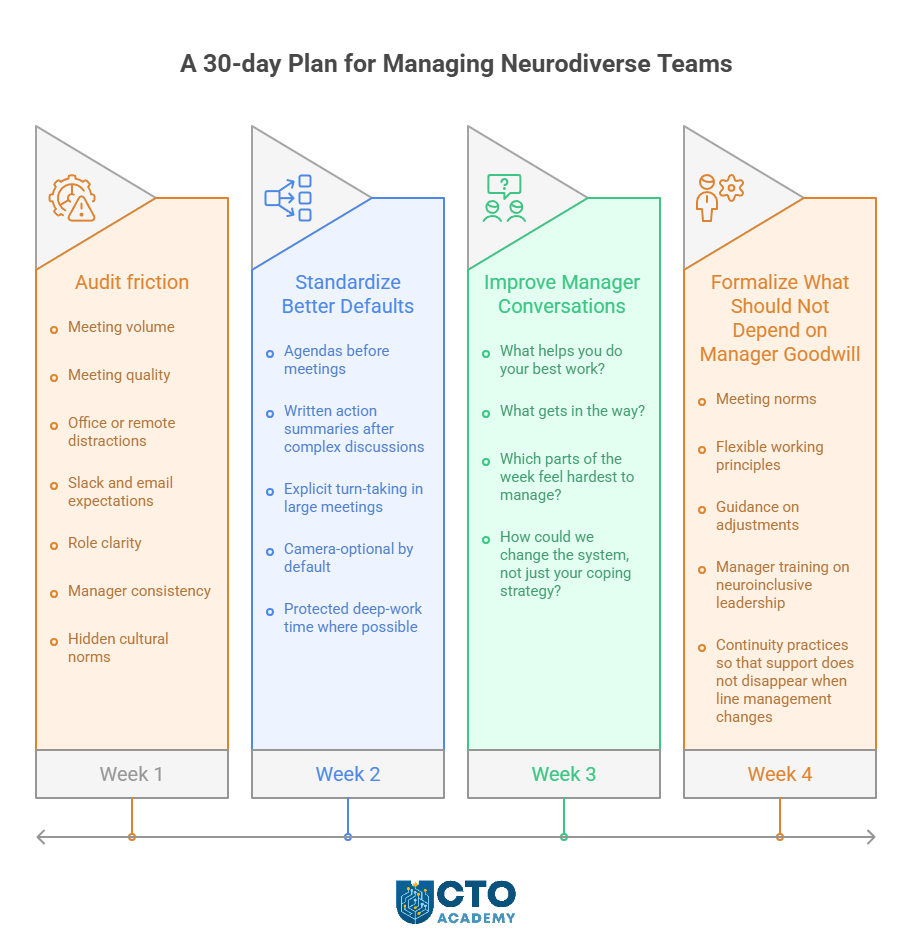
As the graphic suggests, if you want to improve quickly, start here.
Week 1: Audit friction
Review your team’s operating environment:
- Meeting volume
- Meeting quality
- Office or remote distractions
- Slack and email expectations
- Role clarity
- Manager consistency
- Hidden cultural norms
Ask each manager to identify one team ritual that creates unnecessary cognitive load.
Week 2: Standardize Better Defaults
Introduce a few baseline expectations across leadership teams:
- Agendas before meetings
- Written action summaries after complex discussions
- Explicit turn-taking in large meetings
- Camera-optional by default
- Protected deep-work time where possible
Week 3: Improve Manager Conversations
Coach managers to ask better questions:
- What helps you do your best work?
- What gets in the way?
- Which parts of the week feel hardest to manage?
- How could we change the system, not just your coping strategy?
Week 4: Formalize What Should Not Depend on Manager Goodwill
Create or strengthen the mechanisms that make support durable:
- Meeting norms
- Flexible working principles
- Guidance on adjustments
- Manager training on neuroinclusive leadership
- Continuity practices so that support does not disappear when line management changes
This is also where a broader culture conversation can help. CTO Academy’s Balancing Team Support and Executive Pressure case study is a useful related read because it speaks to the leadership tension many senior managers feel between delivery expectations and sustainable people leadership.
The Leadership Takeaway
The most useful lesson from Anette Jacobs’ session is that leading neurodiverse teams well is not about creating a parallel management system. It is about designing a better one.
For senior technology leaders, that means:
- More clarity
- Less ambiguity
- Stronger manager capability
- Better meeting hygiene
- More thoughtful environments
- More flexibility in how people contribute
- Less reliance on unwritten rules
- More attention to how work feels, not just what gets shipped
Do that well, and you create a team that is not only more inclusive, but more resilient, more thoughtful, and more effective.
That is good leadership, full stop.
Ready to become a more effective technology leader?
Explore CTO Academy’s programs, expert-led resources, and leadership community for senior tech professionals navigating the real challenges of scale, people, and execution.
Frequently Asked Questions (FAQ)
What does it mean to manage a neurodiverse team well?
Managing a neurodiverse team well means designing the way your team works so people with different thinking, communication, and processing styles can perform at their best. In practice, that means reducing unnecessary friction, improving clarity, making expectations explicit, and giving people more than one way to contribute.
Is neuroinclusive leadership only relevant if someone has disclosed a diagnosis?
No. Neuroinclusive leadership is useful whether or not someone has formally disclosed a diagnosis. Many of the practices that support neurodivergent colleagues, such as clearer meetings, better documentation, flexible communication, and reduced sensory overload, improve working conditions and performance for the whole team.
What are the biggest mistakes leaders make when managing neurodiverse teams?
The most common mistakes are relying on ambiguity, expecting instant responses to complex questions, overloading people with poorly run meetings, leaving cultural norms unspoken, and treating support as something exceptional rather than part of good leadership. Another common mistake is making assumptions based on labels instead of understanding individual needs.
Do managers need specialist training to support neurodivergent employees?
Managers do not need to become clinical experts, but they do need the skills to lead with clarity, curiosity, and consistency. Good manager training should help them run better meetings, ask better questions, respond calmly under pressure, and make practical adjustments that improve how work gets done.
What are some simple changes that make a team more neuroinclusive?
Simple changes include sharing agendas in advance, writing down decisions and action points, allowing async input before or after meetings, protecting time for deep work, reducing unnecessary interruptions, clarifying priorities, and making team norms more visible. Small operational improvements often make a significant difference.
How can senior technology leaders make neuroinclusion part of team culture?
Senior leaders can make neuroinclusion part of team culture by setting better defaults across the organisation. That includes clearer meeting standards, more thoughtful workload management, better documentation, flexible ways of contributing, and manager expectations that reward clarity rather than constant reactivity. Culture changes when these practices become normal, not optional.
Why does neuroinclusive leadership matter for team performance?
Neuroinclusive leadership matters because it helps remove avoidable barriers to focus, communication, and decision-making. When people are not wasting energy dealing with poorly designed systems, they can contribute more effectively. The result is often a team that is not only more inclusive but also more resilient, more thoughtful, and better able to perform under pressure.