Turn IT Director Readiness Gaps into a Funded Upskilling Plan.
Most employer-funding requests fail because they’re framed as “education.” But the IT Director or CTO role isn’t awarded for effort, potential, or seniority. It’s awarded for building a system that delivers reliability, a secure posture, cost control, service levels, and predictable delivery.
So in Part 2, we’ll do what sponsors actually approve: convert your IT Director or CTO readiness gaps into a 90–180-day delivery plan, attach a conservative ROI model, and hand you a copy-and-paste pitch kit you can use in a real funding conversation.
Don’t ask your employer to fund learning. Ask them to fund a director-ready operating system you’ll ship back into the business.
Recommended:
- Read the full article (Part 1): How to Secure Funding for an MBA in Tech Management →
- Take the IT Director scorecard: IT Director: The Role, the Reality, and a Readiness System to Earn It →
What Changes in Part 2 (and why it works)
In Part 1, we focused on timing, objections, and negotiation tactics for employer funding. Part 2 is the promised sequel: the ROI calculator + the pitch kit—tailored to a specific, sponsor-friendly outcome:
“Fund this because it closes my IT Director readiness gaps with deliverables you can adopt in the next 90–180 days.”
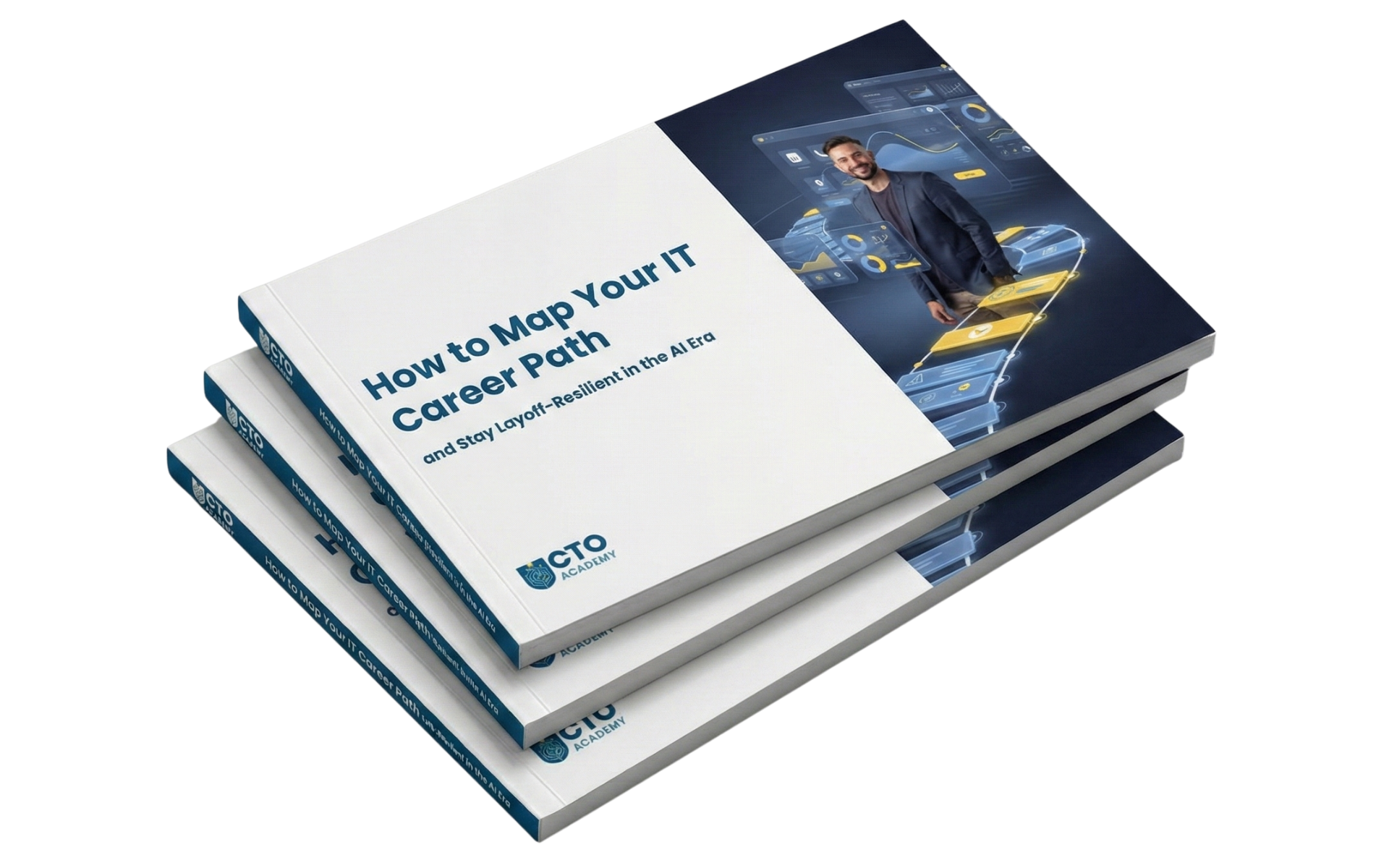
Get the IT Career Path Roadmap (Free PDF)
Want more than scattered ideas? Get our IT Career Path Roadmap PDF – an 8-step framework to map your next roles, sharpen your skills, and build a layoff-resilient tech leadership career. Fill in the form and we’ll send you the PDF version so you can download it, annotate it, and use it as a living plan for your next career moves.
Downloading the ebook does not automatically subscribe you to our bi-weekly Technology Leadership Newsletter.
Step 1: Pick “Fundable Gaps” from the IT Director Readiness Scorecard
Go to the IT Director Role Readiness Scorecard, score yourself honestly, and pick:
- Your lowest 2–3 signals (these become your funding justification)
- One signal you’re already strong at (this becomes your credibility anchor)
The rule: choose gaps that can be turned into artifacts—things your employer can review, adopt, and re-use.
Gap → Deliverable Mapping (Table 1)
Mapping methodology: Readiness gap (signal) → Fundable deliverable (artifact you ship) → Proof the business cares about
| Readiness gap (signal) | Fundable deliverable (artifact you ship) | Proof the business cares about | Digital MBA modules that build this |
|---|---|---|---|
| Risk-based prioritization | Top-5 risk register + mitigation plan + monthly cadence | Fewer surprises, clearer trade-offs | M3: Technology Strategy & Business Goals M6: Information Management M8: Data Science & Analytics |
| Financial discipline | Budget narrative + cost drivers + forecast discipline | Spend predictability, variance explained | M7: Finance & Funding M2: Business Fundamentals M3: Technology Strategy & Business Goals |
| Service model clarity | Service catalog + SLAs/SLOs + reporting | Service levels visible, ownership clear | M5: Product Development M3: Technology Strategy & Business Goals M8: Data Science & Analytics |
| Change governance | Change policy + rollback standard + change failure metrics | Safer releases, reduced operational risk | M5: Product Development M6: Information Management M3: Technology Strategy & Business Goals |
| Incident leadership | Postmortem system + MTTR plan + recurring-issue elimination | Incidents become learning, not drama | M6: Information Management M5: Product Development M1: Leadership & Team Building |
“The CTO Academy’s MBA curriculum doesn’t just teach concepts — it equips you to produce director-level operating artifacts: risk cadence, funding narrative, service model clarity, governance controls, and measurable outcomes.
Jason Noble, CTO
Step 2: Turn Gaps into a 90–180 Day Delivery Plan
For each gap you selected, define five things. This is what makes your request “fundable.”
- Business problem: describe it in exec language (risk, cost, predictability, service levels)
- Deliverable: name the artifact you will ship
- Metric: how improvement will be measured
- Cadence: who reviews it, how often
- Timeline: what ships in 30/60/90 (or 45/90/180)
If your plan doesn’t produce a deliverable that someone can adopt, it’s not sponsor-ready yet.
Step 3: The ROI Calculator (simple, conservative, sponsor-friendly)
Finance doesn’t need perfect numbers. They need transparent assumptions and conservative ranges. The goal is to show that one meaningful improvement can pay back the investment.
ROI Calculator (copy/paste)
ROI CALCULATOR — EMPLOYER-FUNDED IT DIRECTOR UPSKILLING PLAN
A) Program cost
- Tuition/program cost: $ ______
- Time cost (optional): ______ hours x blended rate $ ______ = ______
- Total investment: $ ______
B) Benefit buckets (pick 1–3 only)
- Incident cost reduction
- Major incidents per quarter: ______
- Cost per major incident (downtime + recovery + stakeholder time): $ ______
- Conservative reduction (10–30%): ______
- Annual value estimate: $ ______
- Vendor/license waste reduction
- Annual vendor + license spend (your scope): $ ______
- Conservative savings (2–8%): ______
- Annual value estimate: $ ______
- Delivery predictability/slippage reduction
- Delay cost proxy (missed launches, overtime, rework): $ ______ /year
- Conservative improvement (5–15%): ______
- Annual value estimate: $ ______
- Attrition avoidance (retention ROI)
- Replacement cost proxy (recruiting + ramp + lost productivity): $ ______
- Probability reduction (low/medium/high): ______
- Annual value estimate: $ ______
C) ROI summary
- Total annual value (conservative): $ ______
- ROI ratio: annual value ÷ total investment = ______
- Payback period: total investment ÷ monthly value = ______ months
Sponsor line:
“I’m using conservative ranges. If we only get one improvement—incident cost reduction or vendor optimization—the investment pays back within X months.”
See also: How to Expense Your MBA Course →
Step 4: The Pitch Kit (copy/paste templates)
Everything below is designed to be used exactly as-is. Keep it business-first. Keep it deliverable-led. Keep it measurable.
Template #1: One-page business case
TITLE: Employer-Funded MBA Business Case — IT Director Readiness Delivery Plan
OWNER: [Your name]
ROLE TARGET: IT Director (scope: [teams/systems/services])
1. Why this matters now
- Our environment is pushing harder on reliability, security posture, cost control, service levels, and predictability.
- The IT Director role is accountable for building the operating model that makes those outcomes repeatable.
- This funding request is for a structured delivery program that produces operational artifacts we can adopt immediately.
2. Current gaps (based on IT Director readiness signals)
Top 2–3 gaps I’m addressing:
- [Gap #1] — impact today: [1 sentence on risk/cost/delivery pain]
- [Gap #2] — impact today: [1 sentence]
- [Gap #3] — impact today: [1 sentence]
Credibility anchor (what I already do well):
- [Strength] — evidence: [metric/result/example]
3. What the company gets (deliverables, not “learning”)
Within 90–180 days, I will deliver:
Deliverable A: [Name]
- What it is: [risk register/service catalog/budget narrative/change policy/postmortem system]
- Why it matters: [tie to risk/cost/availability]
- Owner + cadence: [who reviews it, how often]
- Success metric: [MTTR/forecast accuracy/SLA reporting/risk burndown]
Deliverable B: [Name]
- What it is: ______
- Why it matters: ______
- Owner + cadence: ______
- Success metric: ______
Deliverable C (optional): [Name]
- What it is: ______
- Why it matters: ______
- Owner + cadence: ______
- Success metric: ______
4. Investment request
- Tuition: $ ______
- Time plan: [e.g., 4–6 hours/week outside core hours + 1 block/month]
- Support requested: [budget approval/L&D process/manager sponsorship]
5. ROI estimate (conservative)
- Benefit buckets included: [Incident reduction/Vendor optimization/Predictability/Retention]
- Estimated annual value (conservative range): $ ______
- Payback period estimate: ______ months
6. Risk controls (to avoid “education theatre”)
- Monthly checkpoint (30 min) to review deliverables shipped
- Artifacts stored in a shared location and adopted into operating practice
- Success metrics reviewed quarterly with [name/team]
7. Decision requested
Approval to fund the program and sponsor the delivery plan, starting: [date]
Template #2: Email to your manager
SUBJECT: Funding request: IT Director readiness delivery plan (ROI + artifacts included)
Hi [Manager Name],
I’m putting together a practical plan to close a few IT Director readiness gaps—specifically [gap #1], [gap #2], and [gap #3]—by delivering concrete operating artifacts the team can adopt over the next 90–180 days.
Rather than framing this as “education,” I’m proposing an employer-funded program that will produce measurable outputs such as:
- [Deliverable A] (e.g., risk register + cadence)
- [Deliverable B] (e.g., service catalog + SLAs/SLOs + reporting)
- [Deliverable C] (e.g., budget narrative + forecast discipline)
I’ve attached a one-page business case with:
- Deliverables + timelines
- Conservative ROI assumptions (payback estimate included)
- Governance checkpoints to ensure we convert learning into operational improvements
Could we book 30 minutes next week to review and decide whether to move forward?
Thanks,
[Your Name]
Template #3: Email to HR/L&D (formal process)
SUBJECT: Request for employer-funded leadership program tied to operational deliverables
Hi [Name/Team],
I’m submitting a request for employer funding for a leadership program aligned with my progression toward an IT Director role.
This isn’t a general training request. It is a delivery plan to produce specific artifacts that strengthen our operating model in the next 90–180 days, including:
- [Deliverable A]
- [Deliverable B]
- [Deliverable C]
I have a one-page business case outlining:
- Business impact and success metrics
- Manager sponsorship plan
- Conservative ROI assumptions and payback estimate
Please let me know the required steps and documentation to proceed.
Best,
[Your Name]
Template #4: 30-minute meeting agenda + talk track
MEETING GOAL
Align on whether the company will fund the program as an operational delivery initiative, not a personal development expense.
AGENDA (30 min)
- (3 min) Context: why this matters now
- (7 min) The readiness gaps I’m targeting (and why they matter to the business)
- (10 min) Deliverables I will ship in 90–180 days
- (5 min) ROI assumptions + funding request
- (5 min) Risks, checkpoints, and decision
TALK TRACK (use verbatim)
1. Context (3 min)
“Thanks for making time. I’m aiming for the IT Director scope, and the job is fundamentally about building a system that produces repeatable outcomes—availability, security posture, predictable delivery, and disciplined spend.
I’m not asking you to fund learning. I’m asking you to fund a delivery plan that improves our operating model.”
2. Gaps (7 min)
“I’ve assessed myself against IT Director signals. My top gaps are:
- [Gap #1], which shows up today as [concrete issue]
- [Gap #2], which shows up today as [concrete issue]
- [Gap #3], which shows up today as [concrete issue]
I also want to anchor what I already do well: [Strength], and the evidence is [metric/result].”
3. Deliverables (10 min)
“Here’s what the company gets within 90–180 days:
- Deliverable A: [Name]. Value: [business value]. Reviewed: [cadence] with [stakeholders]. Metric: [metric].
- Deliverable B: [Name]. Value: [business value]. Reviewed: [cadence]. Metric: [metric].
- Deliverable C (optional): [Name]. Value: [business value]. Reviewed: [cadence]. Metric: [metric].
These are shared artifacts the team can operate with—not knowledge that sits in my head.”
4. ROI + ask (5 min)
“I’ve used conservative ranges. If we only capture one benefit—reducing major incident cost or optimizing vendor spend—the payback period is approximately [X] months.
The investment request is:
- Tuition: $ ______
- Support: [approval + sponsorship + process]
- Time plan: [your plan]”
5. Risk controls + decision (5 min)
“To avoid this turning into education theatre, I’m proposing:
- A 30-minute monthly checkpoint with you
- Quarterly review of success metrics
- Adoption of the artifacts into team operating practices
If this sounds reasonable, my ask today is approval to proceed with funding and start date.”
Objections You’ll Hear (and the clean responses)
“We don’t have a budget.”
“Understood. If we can’t do the full amount, can we explore a split (L&D + department), reimbursement after milestones, or quarterly payments tied to deliverables shipped?”
“What if you leave?”
“That’s exactly why the deliverables are designed as reusable operating artifacts—risk cadence, service reporting, governance standards. This improves the system regardless of individual retention.”
“Why not a cheaper course?”
“We can absolutely evaluate alternatives. The requirement is that the program produces these deliverables on a structured timeline and upgrades director-level signals: finance, governance, risk prioritization, and executive alignment.”
Your Next Move
Start with clarity, then move to funding:
- Step 1: Score yourself honestly → IT Director: Role + Readiness Scorecard
- Step 2: Pick 2–3 fundable gaps and define deliverables
- Step 3: Run the ROI calculator and send the one-pager
Want the Structured Path (and the fastest conversion to “director proof”)?
If your lowest signals are finance, governance, risk, and executive alignment, a structured program compresses the time it takes to build the artifacts that earn trust.
Learn more about the CTO Academy’s structured program that produces deliverables on a structured timeline:
Additional resources:
Related Internal Links
- Employer-Funded MBA (Part 1): https://cto.academy/mba-in-tech-management-employer-funding/
- IT Director Role Readiness Scorecard: https://cto.academy/it-director-role-readiness-scorecard/
- The Digital MBA for Technology Leaders: https://cto.academy/the-digital-mba-for-technology-leaders/
- How to expense your MBA course: https://cto.academy/how-to-expense-your-mba-course/
- Look inside the Digital MBA: https://cto.academy/look-inside-the-digital-mba-for-technology-leaders/
- Trusted MBA for Technical Professionals: https://cto.academy/accredited-mba-for-technical-professionals/
- CTO Programs Reviews: https://cto.academy/cto-programs-reviews/
- Engineering Manager Promotion Readiness Checklist: https://cto.academy/engineering-manager-promotion-readiness-checklist/
- Leadership Skills Assessment: https://cto.academy/skills-assessment/
- Tech Leader Career Hub: https://cto.academy/tech-leader-career/