What if a product team and its CPO advocate one technology stack, but the engineering team and its CTO another? What if the lines between product and technology are completely blurred, like in organizations that offer purely tech-based products? The solution to both predicaments is often a new breed of leader: the Chief Product and Technology Officer (CPTO).
The CPTO role responds to the growing need for seamless integration between product vision and technological execution. It is at the intersection of strategy, innovation, technology, and leadership and has a single goal: to ensure that technology investments fuel the product roadmap and business goals.
TL;DR
- CPTO = one exec accountable for both product outcomes and technology execution (roadmap + architecture + delivery).
- Best fit when product and tech decisions are inseparable (SaaS/AI platforms) or when you need faster alignment (startups, transformations).
- If you’re deciding between roles, use the CPTO vs CTO vs CPO comparison plus the “who owns what” decision-rights table (roadmap, architecture, reliability, security, etc.).
- To make the role work in practice, implement the CPTO operating system: weekly tradeoffs, shared cadences, a decision log, and explicit delegation/guardrails.
- Measure success with a single CPTO scorecard balancing product outcomes, delivery performance, reliability, security, and cost efficiency.
- Watch for common failure modes (bottlenecking, feature-factory output, misaligned clocks, underinvesting in security) and apply the fixes early.
[Article last updated on February 25, 2026. Updates include: two comparison tables (CPTO vs CTO vs CPO, plus decision ownership), expanded practical sections on organizational design, operating cadence, decision rights, and a CPTO KPI scorecard. It now also includes a clear list of common failure modes with fixes, so you can diagnose issues and apply improvements immediately.]
Table of Contents
Currently, over a dozen CPTO Jobs are posted on the JobLeads platform alone, with an average salary of $220,000. Additional Chief Product & Technology Officer jobs are also posted on Indeed.com.
This article explains the CPTO role: meaning, job description, responsibilities, required skills, challenges, and potential impact on your career trajectory. It also examines when this combined role makes sense for an organization.
Get the IT Career Path Roadmap (Free PDF)
Want more than scattered ideas? Get our IT Career Path Roadmap PDF – an 8-step framework to map your next roles, sharpen your skills, and build a layoff-resilient tech leadership career. Fill in the form and we’ll send you the PDF version so you can download it, annotate it, and use it as a living plan for your next career moves.
Downloading the ebook does not automatically subscribe you to our bi-weekly Technology Leadership Newsletter.
CPTO Job Description, Responsibilities, Required Skills, and Impact
As we said, a CPTO is a technology leader who blends technical expertise with an understanding of product strategy and market needs. They lead cross-functional teams, including engineers, product managers, and designers, to create innovative and successful products.
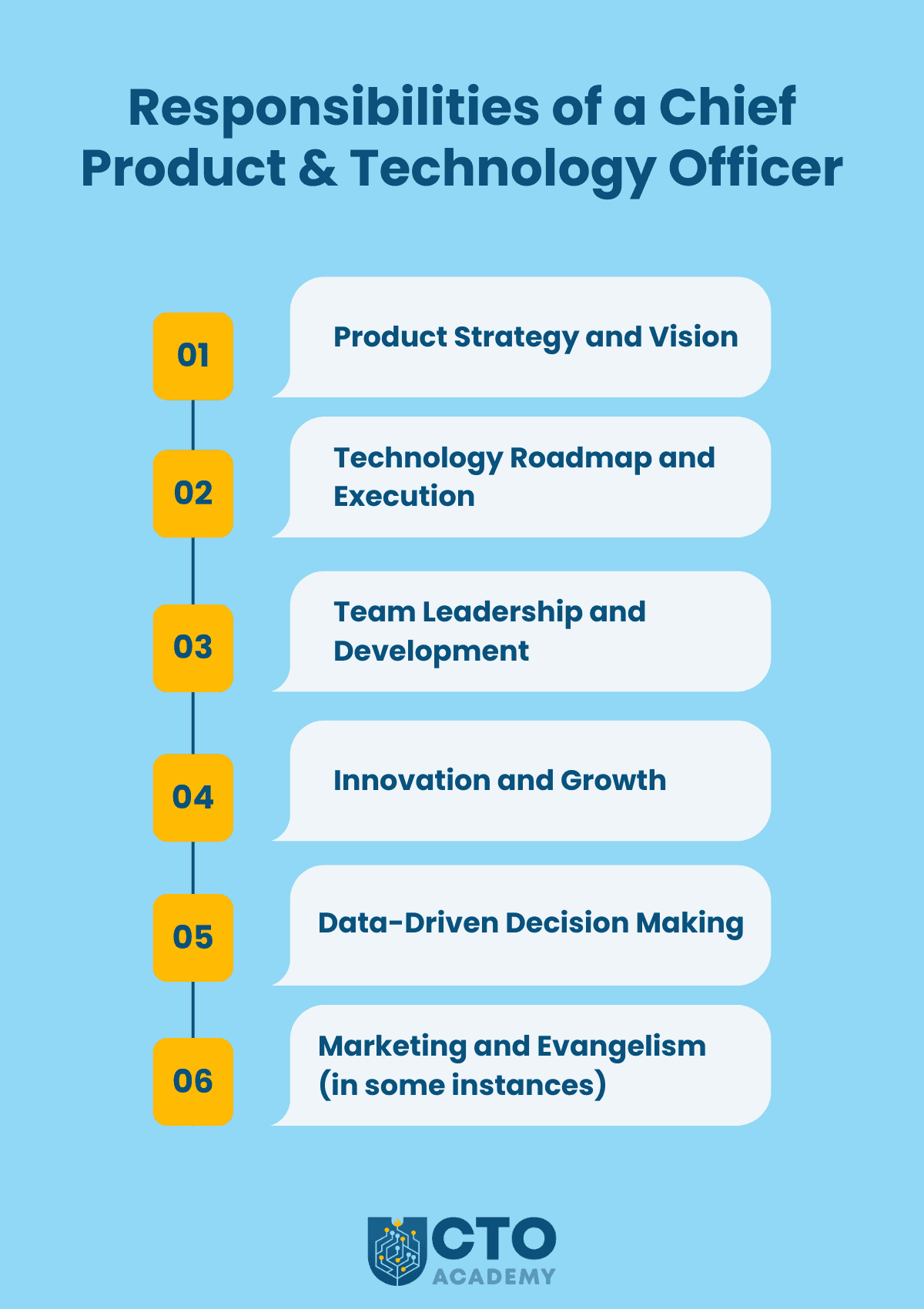
We can see how this process unravels just by looking into the responsibilities of a Chief Product Technology Officer.
Responsibilities
1. Product Strategy and Vision
- Defines the overall product strategy
- Ensures the strategy aligns with the company’s business goals and market opportunities.
- Owns the product roadmap
- Prioritises features
- Guides the product development lifecycle.
2. Technology Roadmap and Execution
- Leads the development and execution of the technology roadmap
- Ensures the roadmap a) supports the product strategy and b) enables efficient product development (eg, technology selection, architecture design, and infrastructure management).
3. Team Leadership and Development
- Leads and mentors cross-functional teams of engineers, product managers, designers, and data scientists.
- Builds and fosters a collaborative and high-performing culture.
4. Innovation and Growth
- Drives innovation by exploring new technologies, identifying emerging trends, and fostering a culture of experimentation.
- Leads new product ideas and guides their development from concept to launch.
5. Data-Driven Decision Making
- Leverages data and analytics to inform product and technology decisions, track progress, and measure success.
- Promotes a data-driven culture across the organization.
6. Marketing and Evangelism (in some instances)
In SaaS-based companies, for example, the CPTO often acts as the head of the Product department; therefore, playing a lead role in marketing the product. In that capacity, the CPTO becomes the lead evangelist for the product. The role then also involves meeting and interacting directly with current and prospective consumers to relay the value and benefits while getting feedback and assessing their reception and experience with the product, much like the Field CTO role.
Skills and Expertise
- Technical Proficiency
- Product Management Expertise (end-to-end, including delivery and customer support)
- Leadership and Communication
- Business Acumen
- Data Analysis and Interpretation
Organisational Impact
- Improved alignment between product and technology teams.
- Enhanced decision-making through joint product and technology perspectives.
- Faster innovation cycles.
- Increased collaboration.
When It Makes Sense to Have CPTO Instead of the Traditional Tech Leadership Duo
Distinguishing Responsibilities
The CTO (Chief Technology Officer) primarily focuses on the technical side of the business (ie, infrastructure, security, architecture, and the engineering team’s execution). In other words, the CTO’s job is to ensure the technology stack is robust, scalable, and aligned with industry best practices.
The CPO (Chief Product Officer), on the other hand, converges the customer and the product vision. The CPO understands user needs, market trends, and the competitive landscape. Based on these factors, the CPO defines the product roadmap, prioritises features, and ensures the product delivers value to users while achieving business goals.
[For more in-depth disambiguation between CTO and CPO roles, read our primer on CTO/CPO differences, friction, and transformative collaboration.]
But in some instances, these two roles merge into a CPTO (Chief Product and Technology Officer) who bridges the gap between product vision and technological execution. However, this is only possible if the CPTO possesses a strong understanding of both domains because the underlying purpose of the role is to achieve a perfect alignment between the product roadmap and the technology strategy.
TABLE 1: CPTO-CTO-CPO comparison table
| Dimension | CPTO (Chief Product & Technology Officer) | CTO (Chief Technology Officer) | CPO (Chief Product Officer) |
|---|---|---|---|
| Primary accountability | One throat to choke for both product outcomes and technology execution | Technology strategy + engineering execution (how the product is built and run) | Product strategy + outcomes (what to build and why) |
| Core mandate | Align product bets with tech realities; optimize for value and feasibility | Build scalable, secure, reliable tech capabilities that enable the business | Maximize customer value and business impact through product direction |
| Typical decisions owned | Prioritization tradeoffs across discovery/delivery; sequencing across product + platform; build vs buy; architecture direction aligned to roadmap | Architecture, platform choices, engineering org model, delivery systems, reliability/security posture | Problem selection, roadmap themes, positioning, packaging inputs, experimentation strategy |
| KPI focus | Balanced scorecard: growth/retention + delivery speed + quality/reliability + cost | Delivery performance, system reliability, security, tech productivity, platform health | Adoption, activation, retention, NPS/CSAT, revenue expansion, roadmap impact |
| What “success” looks like | Faster, cleaner decisions; fewer handoffs; roadmap that ships and scales | Predictable delivery with high quality; resilient systems; strong engineering culture | Clear product strategy; evidence-based prioritization; measurable customer and business outcomes |
| Main internal interfaces | CEO, COO/CRO, Sales/CS, Eng, Product, Design, Data/AI | CEO/COO, Eng, Security, IT/Infra, Data/AI | CEO/CRO, Sales/Marketing, CS, Product, Design, Research |
| Typical scope of org | Product + Engineering (often Design and Data depending on org) | Engineering + Platform/Infra + Security (sometimes Data/AI) | Product + Design + Research (sometimes Data/Analytics) |
| Where the role spends time | Portfolio tradeoffs, roadmap + architecture alignment, org design/cadences, stakeholder alignment | Technical direction, engineering systems, platform investment, risk & resilience | Customer discovery, product strategy, roadmap, GTM alignment, outcome measurement |
| Common failure mode | Becomes a bottleneck or over-weights one side (tech or product) | Builds tech excellence disconnected from market/customer priorities | Drives roadmap without feasibility/operational constraints → delivery friction |
| Best fit contexts | Product-tech coupling is high; need speed/alignment; single product/platform focus | Complex tech stack, reliability/security needs, scale demands | Competitive product strategy needed; multi-segment markets; strong GTM/product motion |
| “Split roles” trigger | Multiple product lines, heavy compliance, large org scale → separate CPO + CTO | If product strategy is unclear or weak → need stronger product leadership | Product + Engineering (often Design and Data, depending on org) |
A faster way to think about it is decision ownership.
TABLE 2: Who owns what
| Area | CPTO | CTO | CPO |
|---|---|---|---|
| Roadmap | Owns | Co-owns | Owns |
| Architecture | Co-owns | Owns | Influences |
| Reliability (SLOs/uptime) | Co-owns | Owns | Influences |
| Pricing & Packaging | Influences | Influences | Co-owns |
| Data/AI (strategy + platform + product use) | Co-owns | Co-owns | Co-owns |
| Security | Co-owns | Owns | Influences |
- Ownership varies by company size and maturity; this shows the most common pattern.
- Co-owns = accountable through shared KPIs/decision rights, even if execution is delegated.
When a CPTO Role Makes Sense?
Resource-Constrained Environments
We are primarily referring to start-ups and smaller companies that require streamlined decision-making and reduced friction between product and technology teams.
A good example is our own CTO, Jason Noble, who, for all intents and purposes, acted (and partially still acts) as the Chief Product & Technology Officer even though it wasn’t his formal role. But during the start-up phase and some time afterwards, his involvement checked all the boxes of the CPTO role.
Product-Led Organisations
That is, companies where technology is inseparable from the product (e.g., SaaS, gaming, AI-driven platforms…). As our next example demonstrates, these companies largely benefit from CPTO’s holistic approach to product development.
DataCamp leverages Gen AI to help engineers move forward when they hit a snag, but that’s also the origin of a contentious choice. The DataCamp engineering team preferred to use the newest LLMs available from OpenAI. The product team, on the other hand, wanted to wait until the models became available from Azure.
Eduardo Oliveira, DataCamp’s Chief Product and Technology Officer, made a decision: The smaller clients could use the faster, newer models, while the bigger companies had the default options of Azure and Microsoft, with an option to use a newer model from OpenAI.
Now imagine a common scenario with CTO and CPO backing their teams. It would take a while before these two find a common ground. This way, however, the decision was instant and, more importantly, flexible and based on mutual satisfaction.
Digital Transformations
When companies are undergoing significant digital shifts, a CPTO can lead the way by ensuring technology serves the evolving product strategy.
Agile Environments
Companies that prioritise agility and rapid iteration often benefit from a CPTO’s ability to quickly align product and technology decisions.
When Separate Roles Make More Sense
- Complex organisational structures.
- Diverse product portfolios.
- Highly specialised technology.
- In instances where the product and technology roadmaps have limited overlap or require very different skill sets.
- Organizations operating in heavily regulated industries (eg, finance, healthcare, or any other that requires high levels of compliance and security).
Organizational Design: Who Reports to a CPTO (and when to split the role again)
A CPTO works best when product and technology are tightly coupled, and the organization benefits from a single prioritization and execution system. To make the role sustainable, define reporting lines, shared interfaces, and “split triggers” early, before scale turns alignment into overload.
Typical reporting lines to a CPTO
In many companies, the CPTO owns an integrated “build organization” that includes:
- Product Management (PMs, Group PMs, Product Ops, where applicable)
- Engineering (Engineering Managers, Tech Leads, QA/Quality Engineering)
- Design (Product Design, UX Research, sometimes via a Design Director)
- Data/AI (varies by company):
- If data/AI is core to the product: Data Engineering/ML Platform/Applied ML often sits under CPTO or is co-led with a Head of Data/AI.
- If data is enterprise-wide, it may sit under COO/CIO with strong dotted-line alignment to CPTO.
Common dotted-line partners (usually not direct reports):
- Security (CISO/Head of Security)
- IT/Corporate systems
- Revenue org leaders (CRO, Sales, Customer Success) for roadmap alignment and customer feedback loops
Remember:
The goal isn’t “CPTO owns everything.” The goal is one decision system for product bets, technical feasibility, and delivery capacity.
Two practical patterns that work well
Pattern A: Integrated Product + Engineering (most common)
- Product and Engineering report directly to CPTO.
- Design and Data/AI either report to CPTO or are tightly partnered with clear shared metrics.
Pattern B: Platform + Product Lines
- CPTO oversees Product + Engineering, with an explicit split between:
- Product-line teams (customer-facing outcomes).
- Platform teams (reliability, developer experience, shared services).
- This pattern reduces roadmap friction and prevents platform work from being perpetually deprioritized.
“Split triggers”: when it’s time to separate CPO and CTO again
Even if the CPTO model works initially, scaling can create a natural need to split roles. Consider separating CPO and CTO when you see one or more of the following:
- Multiple product lines/markets with conflicting strategies and GTM needs.
- High regulatory burden (finance, health, critical infrastructure), where security/risk leadership becomes a full-time executive focus.
- Rapid headcount growth (coordination cost rises; leadership bandwidth becomes the constraint).
- Deep technical specialization required (e.g., heavy infra/platform, complex AI/ML, embedded/hardware).
- Reliability is existential (availability, latency, safety, compliance) and requires dedicated executive attention.
- M&A or multi-platform integration where architecture complexity dominates.
Rule of thumb:
If the CPTO is spending most weeks making either product strategy calls or technology risk calls—and the other area is consistently under-served—it’s time to split.
If you keep the CPTO role at scale, reduce overload with explicit structure
- Appoint strong “second-in-command” leaders: VP Product and VP Engineering (or equivalents).
- Make platform/reliability/security investment non-negotiable via capacity allocation.
- Keep a single scorecard, but assign clear owners per metric category.
- Protect focus time: fewer meetings, more decision clarity, more delegation.
Operating Model: How a CPTO Runs the Organization
A CPTO’s job is to turn strategy into a repeatable decision-and-delivery system—where product bets, technical direction, and execution capacity stay aligned week after week (not just at quarterly planning).
The CPTO Operating System (the “minimum viable” version)
Most high-performing CPTOs rely on a small set of cadences + artifacts + decision rights:
Cadences
- Weekly: Prioritization & tradeoffs (60–90 min)
One meeting to resolve the hard calls: what ships, what slips, what gets staffed, and what is blocked by dependencies. - Weekly or biweekly: Product discovery review (45–60 min)
Validate problem selection, experiment design, and learning velocity (not feature status). - Biweekly: Delivery/execution review (45–60 min)
Focus on flow: blockers, scope creep, cross-team dependencies, and time-to-value. - Monthly: Architecture & platform review (60–90 min)
A lightweight forum to prevent “architecture by Slack” and align platform investment with roadmap needs. - Quarterly: Planning + capacity allocation (half-day to 2 days)
Agree on themes, measurable outcomes, and an explicit capacity split (e.g., product bets vs platform vs risk reduction).
Core artifacts (keep these simple and public)
- Outcome roadmap (themes + measurable outcomes, not just features).
- Tech roadmap (platform investments tied to business outcomes).
- Decision log (what we decided, why, and what we’ll revisit).
- Capacity model (who is working on what and what gets deprioritized).
- Scorecard (a small set of KPIs spanning product outcomes + delivery health + reliability/security).
Decision Rights: What the CPTO Decides vs Delegates
The CPTO should own the decision framework, but avoid becoming the bottleneck.
CPTO should personally own:
- Portfolio-level prioritization (product bets vs platform vs risk work).
- Roadmap sequencing when tech constraints and customer value collide.
- Build vs buy tradeoffs with clear evaluation criteria.
- Cross-org dependencies and “who decides” conflicts.
- Hiring/structure decisions for Product + Engineering leadership.
CPTO should delegate (but stay accountable through metrics):
- Technical implementation details (to engineering leadership).
- Day-to-day delivery execution (to EMs/TPMs).
- Specific domain roadmaps (to PMs/Group PMs and tech leads).
If everything requires CPTO approval, the org will slow down. A strong CPTO builds a system where teams can decide quickly inside clear guardrails.
A Practical Template for Fast Alignment (use this in every meeting)
When tradeoffs appear, resolve them with the same set of questions:
- What outcome are we optimizing for? (customer value + business impact)
- What’s the constraint? (reliability, security, time, cost, dependencies)
- What’s the smallest bet that proves/disproves the hypothesis?
- What are we explicitly NOT doing this cycle? (make deprioritization visible)
If unsure how to create it, use this decision-making framework template.
First 30 Days: What a New CPTO Should Implement
- Publish a single shared roadmap view (outcomes + delivery milestones).
- Establish a weekly tradeoff cadence and a decision log.
- Define capacity allocation (what % goes to roadmap vs platform vs risk).
- Align on scorecard metrics across Product + Engineering.
- Clarify decision rights (who owns what, what escalates).
CPTO KPIs
A CPTO is accountable for results (product impact) and the system that produces results (delivery capability, reliability, security, and cost).
The simplest way to manage that tension is a single scorecard that Product and Engineering review together. But the scorecard must balance product outcomes and engineering health.
The CPTO Scorecard (recommended categories)
1) Product outcomes (are we creating value?)
- Adoption & activation: % of users reaching “aha” moments, onboarding completion, and feature adoption.
- Retention & engagement: churn/retention, DAU/MAU (or equivalent engagement signals).
- Customer value: NPS/CSAT, support ticket trends, and time-to-value.
- Business impact: revenue growth/expansion (where relevant), conversion rate, and ARPA/ARR impact per initiative.
2) Delivery performance (can we ship predictably?)
- Lead time: idea → shipped (or PR → production, depending on level).
- Throughput: meaningful releases per period (avoid vanity “number of tickets”).
- Predictability: planned vs delivered (variance), roadmap stability.
- Quality: escaped defects, rollback rate, and incident rate linked to recent changes.
3) Reliability & operational excellence (can customers trust it?)
- SLO attainment: uptime, latency, error rate, and availability by critical user journey.
- MTTR: mean time to restore (how fast you recover).
- Change failure rate: how often deployments cause incidents.
- Operational load: on-call burden, toil percentage.
4) Security & risk (are we reducing exposure?)
- Critical vulnerabilities: time-to-patch, open critical/high findings.
- Security posture: compliance controls coverage, audit outcomes (where relevant).
- Access hygiene: privileged access reviews, MFA coverage, secrets rotation cadence.
- Data risk: incidents, data classification coverage, model/data governance maturity (if AI).
5) Cost & efficiency (is the platform sustainable?)
- Infrastructure cost per customer/per transaction.
- Cloud spend variance: forecast vs actual; unit economics trends.
- Engineering efficiency: % time in feature work vs toil; rework rate.
- Platform leverage: reuse rate, internal developer satisfaction (DX), build times.
How to Use the Scorecard (without turning it into bureaucracy)
- Review Product outcomes + Delivery + Reliability weekly/biweekly (keep it short).
- Review Security + Cost at least monthly, or whenever risk/spend spikes.
- Tie the major initiatives to one primary outcome metric and one guardrail metric (e.g., activation ↑ while error rate stays within SLO).
The CPTO’s job isn’t to maximize every metric. It’s to make tradeoffs explicit and keep the organization aligned on what matters this quarter.
Quick-starter Set of metrics (if you want the minimum viable version)
If you need to start simple, pick 8–10 metrics total:
- Activation, retention, NPS/CSAT (or support volume trend).
- Lead time, predictability variance, and escaped defects.
- SLO attainment and MTTR.
- Critical vulnerability time-to-patch.
- Infra cost per customer/transaction.
Charting a Career Roadmap
The CPTO role is a relatively new addition to the tech leadership landscape, and the path to this position may not be as clearly defined as traditional roles like CTO or CPO. However, with the right blend of skills, experience, and strategic planning, you can successfully navigate your way to this position. Let’s see what you need to do if you are a CTO, CPO, or Tech Lead.
CTO-to-CPTO
- Expand your focus beyond technology to encompass product strategy, user experience, and market analysis.
- Seek opportunities to collaborate closely with product teams.
- Contribute to product roadmaps.
- Develop a deeper understanding of the customer.
CPO-to-CPTO
- Strengthen your technical foundation by immersing yourself in the technology that powers your products.
- Gain a solid understanding of software development principles, architectural patterns, and emerging technologies.
- Collaborate closely with engineering teams and actively participate in technical discussions.
Senior Engineers/Tech Leads-to-CPTO
- Develop your leadership skills by taking on larger projects, mentoring junior engineers, and actively contributing to strategic decisions.
- Seek opportunities to lead cross-functional initiatives.
- Demonstrate your ability to bridge the gap between technology and product.
Developing Essential Skills
- Consider pursuing advanced degrees like an MBA or a Master’s in Technology Management to gain a broader business and leadership perspective.
- Enrol in targeted training programs (like those offered by CTO Academy) that focus on product strategy, leadership development, and technology management.
- Seek out roles that provide exposure to both product and technology, such as leading cross-functional teams, managing product development lifecycles, or contributing to technology roadmaps.
- Stay ahead of industry trends, emerging technologies, and best practices in both product and technology through online courses, conferences, and industry publications.
How to Answer the Challenges of the Role?
The CPTO role requires a broad understanding of both product and technology. Therefore, focus on developing a strong foundation in both areas while leveraging your team’s expertise for deeper dives.
Another challenge is aligning product and technology teams. This requires strong communication, collaboration, and leadership, but above all, a culture of shared ownership and accountability.
Speaking of team alignment, what about conflicting priorities?
We all know that balancing the demands of product development with the complexities of technology management can be really challenging, don’t we?
To solve this problem, you must establish a very clear and adaptable decision-making framework. In other words, base all decisions on a strong framework that provides consistent guidance while allowing for flexibility when needed. (get the decision-making framework template here)
However, even that won’t help if you fail to develop strong prioritisation skills. Perfecting your prioritisation skills plays a pretty much pivotal role because, as a CPTO, you are constantly balancing between product development and technology initiatives. That’s why our Digital MBA for Technology Leaders involves different aspects of prioritisation within their broader topics, offering insights that help technology leaders improve their prioritisation skills.
Let’s now briefly explain the most common failure modes so you can better understand the challenges of the role.

Common CPTO Failure Modes (and how to fix them)
Combining Product and Technology leadership creates speed and alignment, but it also creates predictable failure modes. Use the list below as a diagnostic: if you recognize the symptom, apply the fix immediately.
1) The CPTO becomes the bottleneck
Symptom: Everything requires CPTO approval. Decisions queue up. Teams wait, momentum slows, and “alignment” turns into paralysis.
Fix:
- Define decision rights and guardrails.
- Push decisions down with clear escalation rules (e.g., “Only cross-team tradeoffs, major spend, or security exceptions escalate”).
- Create a lightweight decision log so teams learn how decisions are made.
Quick test: If you’re in more than one meeting where you’re approving the same type of decision, that decision should be delegated.
2) Over-indexing on technology excellence at the expense of customer value
Symptom: Beautiful architecture, slow impact. Platform work crowds out outcomes, and customers don’t feel progress.
Fix:
- Tie platform investments to explicit product outcomes and pick one primary outcome metric + one guardrail per initiative.
- Use a capacity split (e.g., bets vs platform vs risk reduction), so tradeoffs are transparent.
3) Over-indexing on product demand at the expense of feasibility and reliability
Symptom: Roadmaps churn, teams thrash, reliability declines, and delivery becomes reactive.
Fix:
- Make feasibility a first-class input: enforce “definition of ready” for bets (dependencies, risk, security, performance).
- Reserve capacity for reliability and tech debt.
- Protect SLOs as non-negotiable guardrails.
4) Feature factory mode (shipping output, not learning)
Symptom: Lots of activity, unclear impact. Roadmaps are feature lists; experiments are rare; success is “we shipped it.”
Fix:
- Switch the roadmap to outcomes + hypotheses.
- Require evidence checkpoints: problem validation, experiment plan, and post-launch measurement.
- Reward teams for learning velocity and measurable impact.
5) Product and Engineering run on different clocks
Symptom: Discovery moves fast, delivery moves slow (or the reverse). Plans don’t sync; handoffs cause rework.
Fix:
- Implement a shared operating cadence: weekly tradeoffs, biweekly discovery review, execution review, and a monthly architecture/platform review.
- Align on the same scorecard and define shared definitions of “done.”
6) “Shadow priorities” from stakeholders
Symptom: Sales escalations and exec asks continuously override plans; teams constantly pivot.
Fix:
- Create a single intake and prioritization process with visible tradeoffs.
- Use a simple rule: “If it’s urgent, we decide what it displaces.”
- Make deprioritization public.
7) Under-investing in security and risk until it becomes a crisis
Symptom: Security is treated as a checklist; vulnerabilities pile up; incidents surprise the org.
Fix:
- Put security on the scorecard (time-to-patch, critical findings, control coverage).
- Establish clear exception handling (who can accept risk, for how long, with what compensating controls).
Conclusion
The role is in demand, with many open positions and competitive salaries. However, it does require a specific blend of technical proficiency, product management expertise, leadership, communication, business acumen, prioritization, and data analysis skills.
On the other hand, if you successfully bridge the almost inevitable gap between product vision and technology execution, it will most certainly lead to improved alignment between product strategy and technology investments, enhanced decision-making, faster innovation, and increased collaboration within an organisation.
Therefore, whether you’re a CTO seeking to expand your influence, a CPO looking to deepen your technical expertise, or a senior engineer with aspirations of leading at a higher level, the CPTO path presents a compelling opportunity in technology and product development.
Frequently Asked Questions (FAQ)
What is a CPTO (Chief Product & Technology Officer)?
A CPTO is an executive who owns both product outcomes and technology execution. The role exists to ensure product strategy, roadmap priorities, architecture decisions, and delivery capacity are aligned under one decision-making system, reducing friction and improving speed.
What does a CPTO do day to day?
A CPTO runs the operating system that keeps product bets and execution aligned: setting priorities, resolving tradeoffs, removing dependencies, and keeping teams focused on measurable outcomes. Practically, that means maintaining a shared roadmap view, reviewing discovery and delivery flow, and ensuring platform, reliability, and security work don’t get deprioritized.
How is a CPTO different from a CTO?
A CTO primarily owns technology strategy and engineering execution: architecture, platform choices, reliability, security posture, and how engineering operates.
A CPTO owns those responsibilities and product outcomes, meaning they also lead product strategy/roadmap decisions and balance customer value against technical feasibility, risk, and cost.
How is a CPTO different from a CPO?
A CPO primarily owns product strategy and outcomes: customer needs, market fit, roadmap themes, prioritization, and product impact metrics.
A CPTO owns those responsibilities and technology execution, ensuring roadmaps can ship predictably and scale sustainably.
When does it make sense to have a CPTO instead of separate CTO + CPO roles?
A CPTO model works best when product and technology decisions are inseparable (common in SaaS, gaming, and AI-driven platforms), when speed and alignment are critical, and when an organization benefits from a single leader resolving tradeoffs across product bets, platform investment, reliability, and security.
When is combining the roles a bad idea?
It’s often a poor fit in complex organizational structures, diverse product portfolios, highly specialized technology environments, or heavily regulated industries where security, compliance, and risk require dedicated executive focus. It can also fail when leadership bandwidth becomes the constraint as the organization scales.
What does a CPTO typically “own,” vs “co-own,” vs “influence”?
Most commonly: CPTO owns the roadmap alongside the CPO’s domain ownership, co-owns architecture, reliability, data/AI strategy, and security outcomes with the CTO (or equivalent leaders), and influences pricing/packaging decisions with commercial and product leaders. In practice, “co-own” means shared KPIs and explicit decision rights.
What teams usually report to a CPTO?
In many organizations, Product and Engineering report to the CPTO, and sometimes Design and Data/AI (especially when AI is core to the product). Security and IT often remain separate executive functions but partner through dotted-line alignment and shared metrics.
What are the most important KPIs for a CPTO?
A CPTO scorecard should balance product outcomes (adoption, retention, customer value, business impact) with delivery performance (lead time, predictability, quality), reliability (SLO attainment, MTTR, change failure rate), security/risk (time-to-patch, critical findings, posture), and cost efficiency (unit economics like infra cost per customer/transaction).
What are the most common CPTO failure modes?
The big ones are becoming a bottleneck, over-indexing on technology excellence at the expense of customer value, over-indexing on product demand at the expense of feasibility/reliability, drifting into “feature factory” output, running product and engineering on different cadences, allowing stakeholder “shadow priorities,” and under-investing in security until it becomes a crisis.
What should a new CPTO do in the first 30–90 days?
Start by establishing one shared roadmap view (outcomes + milestones), a weekly tradeoff cadence, and a lightweight decision log. Then define capacity allocation (roadmap vs platform vs risk), align Product and Engineering on a single scorecard, and clarify decision rights so teams can move fast without escalating everything.
What background makes the best CPTO (CTO vs CPO vs engineering leader)?
Strong CPTOs can come from either side, but they must develop credibility in both. CTOs moving into CPTO typically need to deepen customer and product strategy skills; CPOs moving into CPTO need a stronger technical foundation and comfort with architecture, reliability, and security tradeoffs; senior engineering leaders need broader product strategy exposure and cross-functional leadership experience.