CDGO or Chief Digital Growth Officer is a senior executive (C-suite leader) responsible for driving measurable growth through the digital systems that create and capture value: product experience, data and analytics, platforms, and the cross-functional operating model behind them.
In simple terms, a CDGO owns growth outcomes (revenue, retention, conversion, efficiency) and makes them repeatable through digital strategy, execution, and governance.
Where you’ll see the CDGO role:
- Enterprises modernizing digital commerce and customer experience.
- Consumer brands scaling eCommerce and omnichannel growth.
- SaaS scaleups formalizing product-led growth and experimentation.
- Platform businesses optimizing marketplace dynamics through product and analytics.
What you’ll get from this guide:
- A clear, practical definition of the CDGO role (and how it differs from CDO/CGO).
- A breakdown of core responsibilities, KPIs, and the operating cadence that CDGOs run.
- The most common career paths into the role for tech/product/digital transformation leaders.
- What employers expect at the interview level — plus a ready-to-use 90-day plan template.
- Realistic salary expectations and compensation patterns across startups, scaleups, and enterprises (UK + US).
TL;DR
A Chief Digital Growth Officer (CDGO) is a C-suite leader who owns growth outcomes—revenue, retention, conversion, and efficiency—by building the digital operating system behind them: product experience, platforms, data/measurement, experimentation, and cross-functional execution.
This guide breaks down the CDGO mandate, the KPI scoreboards by business model (eCommerce, SaaS, marketplaces), how the job runs week-to-week and quarter-to-quarter, what employers screen for in interviews, realistic UK/US compensation expectations, and a practical 30/60/90-day CDGO action plan template you can reuse on day one.
How this guide was built:
This guide synthesizes real-world recruiter/job-post patterns, executive role comparisons (CDO vs CGO vs CDGO), CTO Academy Tech Leaders Community inputs, and a UK salary benchmark for the CDGO title; then translates it into practical cadences, KPIs, and interview-ready artifacts.
Table of Contents
Get the IT Career Path Roadmap (Free PDF)
Want more than scattered ideas? Get our IT Career Path Roadmap PDF – an 8-step framework to map your next roles, sharpen your skills, and build a layoff-resilient tech leadership career. Fill in the form and we’ll send you the PDF version so you can download it, annotate it, and use it as a living plan for your next career moves.
Downloading the ebook does not automatically subscribe you to our bi-weekly Technology Leadership Newsletter.
What is a Chief Digital Growth Officer (CDGO)?
A Chief Digital Growth Officer (CDGO) is a C-suite operator who blends digital transformation leadership with growth accountability. The role exists to turn “digital” from a set of projects into a repeatable growth engine. This is achieved through a multi-layered process that links strategy, product experience, data/measurement, platforms, and cross-functional execution to measurable outcomes (revenue, retention, conversion, efficiency).
CDGO vs CDO vs CGO (simple comparison)
CDGO = the blend. Think of it as a “CDO + CGO” hybrid with a bias toward building durable systems for growth.
- CDO (Chief Digital Officer) typically owns digital strategy and transformation: modernizing the business through technology, redesigning customer experiences, and driving cross-functional change. The CDO role is often described as operating at the intersection of business strategy and digital capability, with transformation as the center of gravity.
- CGO (Chief Growth Officer) owns growth strategy across functions, keeping customer-centric growth top of mind and coordinating across silos (often spanning marketing, sales, product, and beyond).
- CDGO (Chief Digital Growth Officer), on the other hand, owns growth outcomes, but does it through the digital operating system: product/platform roadmap, data and measurement discipline, experimentation, and the operating model that makes growth repeatable. When you compare CDGO job descriptions, you can see that they explicitly combine cross-functional ownership (digital experience, customer insights, growth engineering) with forecasting and executive reporting on growth strategy.
In practice:
CDO = “make the company digital”; CGO = “make the company grow”; CDGO = “make growth happen through digital systems.”
Chief Digital Growth Officer (CDGO) Job Description (summary)
- Own digital growth outcomes: revenue, retention, conversion, and efficiency (LTV/CAC, payback).
- Define and manage the growth KPI tree and reporting cadence (weekly/monthly/quarterly).
- Lead the digital growth roadmap across product experience, platform capabilities, and data/analytics.
- Build and scale an experimentation system (hypotheses, testing, learnings, rollout decisions).
- Align cross-functional teams (product, engineering, marketing/RevOps, finance) around priorities and trade-offs.
- Create executive-ready investment cases and resource plans tied to measurable impact.
- Ensure growth scales with governance (privacy, security, compliance, data quality guardrails).
Why the Role is Emerging Now
The CDGO role is increasingly showing up because many organizations have learned the hard way that digital transformation without growth accountability becomes a portfolio of initiatives, while growth without strong digital foundations becomes fragile and hard to scale.
Four forces are pushing the blend:
1. There is a constant growth pressure. Leaders want one accountable owner who can unify growth across functions rather than splitting it across marketing/product/tech.
2. For a while now, digital channels dominate growth. The fastest path to revenue, retention, and margin improvements runs through digital experience and platform capabilities – even in OT.
3. Boards now expect growth leaders to run with instrumentation, forecasting, and operational rigor, not “campaign results.” In other words, they expect measurements. Many CDGO job postings emphasize just that: analytics ecosystems, insights, and executive-level reporting on forecasts and projections.
4. The final force is the platform-first transformation because companies increasingly frame growth as something unlocked by owning a platform and scaling it. Press releases for newly created CDGO roles explicitly cite accelerating growth by leveraging digital platforms and expanding platform impact.
That being said, one question remains: Why would you opt for this particular career path instead, for example, Head of Engineering or CTO?
Why Choose the CDGO Path (instead of staying on the Head of Engineering/CTO track)?
For many senior tech and product leaders, the CDGO path is attractive because it offers broader business ownership and a clearer line of sight to measurable commercial outcomes, all without giving up the strategic leverage of technology. Here is a simple checklist to see if this role is something worth pursuing given your short- and long-term career plans.
You might prefer the CDGO trajectory if you want to:
- Own growth outcomes, not just delivery. CTO/HoE roles often get measured on reliability, velocity, cost, and technical quality. In contrast, CDGOs are measured on revenue, retention, conversion, LTV/CAC efficiency, and are empowered to change the system if they have to just to move those numbers.
- Operate at the intersection of product, data, and go-to-market. A CDGO role is designed for leaders who enjoy shaping the full growth engine: product experience, experimentation, analytics, lifecycle, and cross-functional execution.
- Move from “how we build” to “what we build and why.” Many engineering leaders want more influence over prioritization, investment decisions, and business strategy. That’s why they choose this career path, because CDGO typically sits closer to the portfolio and P&L conversation.
- Become the executive who makes growth repeatable. Rather than being pulled into one-off transformations, the CDGO mandate is to build a durable operating system for growth: metrics, governance, cadence, and scalable platforms.
- Increase executive leverage (and often compensation upside). The role commonly comes with higher upside through bonuses, equity, and strategic scope, because performance ties directly to business results.
When is the CTO/HoE track the better fit?
It makes sense if your highest motivation is deep technical architecture, engineering excellence, platform reliability, and technical strategy as the primary mandate. CDGO is best for leaders who want technology to be the means, with growth as the scoreboard.
Universal Responsibilities of a CDGO Role
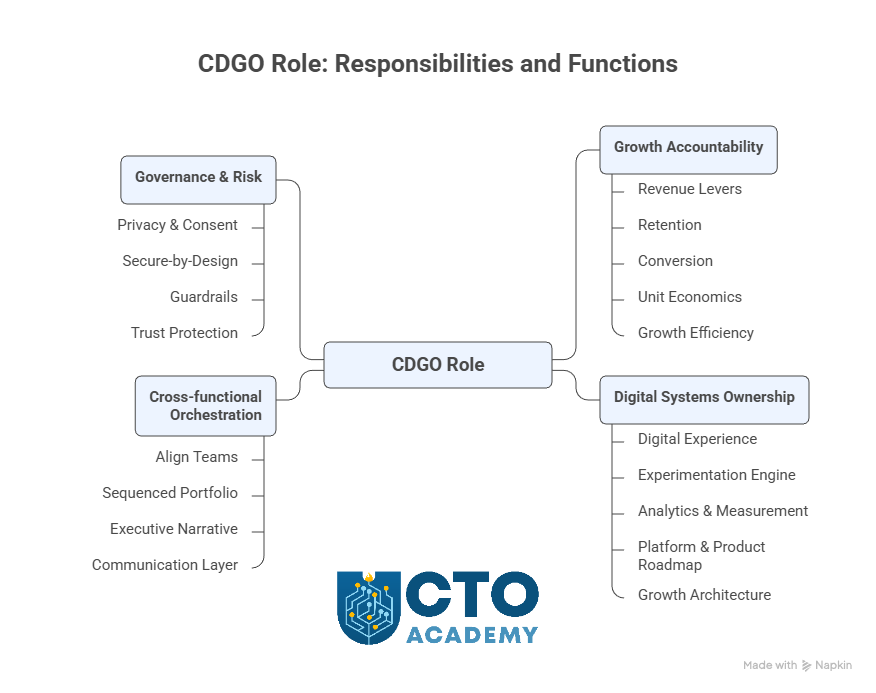
The title varies by company, but the CDGO mandate is remarkably consistent: own growth outcomes and build the digital systems and operating model that make those outcomes repeatable. If you’re reading CDGO job descriptions and they feel inconsistent, use this as your canonical checklist (these responsibilities show up whether the company is a startup, scaleup, or enterprise):
1. Growth Accountability (outcomes)
A CDGO is accountable for measurable growth. That doesn’t always mean they “own Sales,” but it does mean they own the growth levers the business can reliably pull through digital channels.
Typical outcomes that a CDGO is expected to move:
- Revenue levers: digital revenue growth, ARPA/ARPU, average order value, and expansion revenue.
- Retention: churn reduction, repeat purchase rate, renewal rates, cohort retention.
- Conversion: funnel conversion, activation rates, onboarding completion, checkout conversion.
- Unit economics: LTV, CAC, CAC payback, contribution margin, cost-to-serve efficiency.
- Growth efficiency: experimentation velocity, time-to-impact, ROI on digital investments.
2. Digital Systems Ownership (means)
CDGO is not a “growth strategy in a slide deck.” Instead, it is growth through a digital operating system that is capable of making improvement continuous, measurable, and scalable.
Core “means” a CDGO typically owns or heavily influences:
- Digital experience: customer journeys, UX, performance, personalization, friction removal.
- Experimentation engine: hypothesis pipeline, A/B testing (or equivalent), learning reuse, rollout discipline.
- Analytics & measurement: instrumentation, KPI definitions, dashboards, attribution/causality thinking, insight-to-action loops.
- Platform & product roadmap: prioritization across platform capabilities, data products, internal tooling, and customer-facing features.
- Growth architecture: lifecycle mechanics (activation → engagement → retention), pricing/packaging inputs, and product-led pathways (where relevant).
3. Cross-functional Orchestration
Chief Digital Growth Officer’s work is inherently cross-functional because growth is cross-functional. The role exists to align teams that otherwise optimize locally (e.g., engineering for delivery, marketing for campaigns, finance for cost control) into one coherent growth system.
This is how orchestration works in practice:
- Align product, engineering, marketing, RevOps, and finance around a shared KPI tree and priorities.
- Translate business goals into a sequenced portfolio (not a backlog) with clear owners and measurable impact.
- Build an executive-ready narrative: what we’re doing, why it matters, what’s working, what’s not, and what we’re changing.
- Run the communication layer: stakeholder management, expectation-setting, trade-off calls, and decision clarity.
4. Governance & Risk
As a CDGO, you don’t get to choose between growth and control; you must deliver both. That means explicitly managing the trade-offs that appear when you scale experiments, data usage, and automation.
In that role, you are expected to:
- Make privacy and consent part of the growth system (not a late-stage review).
- Partner with security/legal/compliance to ensure secure-by-design changes and safe experimentation.
- Balance speed with risk through guardrails: data governance, model governance (if AI is used), release controls, and auditability.
- Protect trust while pursuing performance because “growth at any cost” is a liability in regulated or brand-sensitive environments
Remember:
A CDGO isn’t defined by one department. The role comes down to a single responsibility and that is making growth outcomes repeatable through digital systems, cross-functional execution, and governance.
What Does a Chief Digital Growth Officer Do Day-to-Day?
A CDGO’s calendar looks less like “projects and status updates” and more like an operating system for growth. The job is to create a tight feedback loop between what the business needs, what the digital system is producing, and what gets prioritized next. And all of this with clear decisions, measurable impact, and fast learning cycles.
Let’s go over the operation cadence of CDGOs to better understand how it feels wearing that hat during a single week, a single month, or a quarter.
Weekly Cadence
Weekly rhythms are about speed and signal: spotting what’s moving, what’s breaking, and what requires immediate attention/intervention.
Most CDGOs run a weekly cycle that includes:
- Growth review: the KPI dashboard that matters (revenue, retention, conversion, activation, efficiency) and what changed since last week.
- Experiment review: what shipped, what learned, what scaled, what stopped, plus “next bets” and resourcing decisions.
- Funnel health check: where users/customers drop, friction points, performance anomalies, and cohort movement.
- Delivery risk scan: dependencies, data-quality issues, platform bottlenecks, and anything that threatens speed-to-impact.
A practical rule: weekly meetings should end with three decisions: 1) what we double down on, 2) what we pause, and 3) what we change.
Monthly Cadence
Monthly cycles are where the CDGO prevents “activity drift” and keeps the org aligned on the highest-ROI work.
Common monthly motions:
- Portfolio reprioritization: adjust the growth roadmap based on evidence, not opinions; in other words, rebalancing bets across acquisition, activation, retention, and monetization.
- KPI/OKR calibration: refine targets and leading indicators, tighten definitions, and ensure teams are optimizing toward the same scoreboard.
- Budget trade-offs: shift investment toward what works (and away from what doesn’t), aligning spend with measurable performance.
This is also where many CDGO job specs emphasize owning measurement and analytics tied directly to revenue outcomes, because the monthly cycle is where performance becomes resource allocation.
Quarterly Cadence
Quarterly is the “board-level” tempo: strategy, investment, capability, and organization design. It’s where the CDGO makes the growth engine more durable and not just faster.
A strong quarterly cycle includes:
- Strategy refresh: update the growth strategy based on market reality, customer signals, and performance trends.
- Investment cases: define where the next quarter’s growth will come from, and what capabilities (platform, data, product) must be funded to unlock it.
- Capability gap review: identify missing competencies (analytics depth, experimentation maturity, product discovery, lifecycle mechanics) and fix them through hiring, upskilling, or org changes.
- Org design decisions: clarify ownership boundaries across product, engineering, marketing, RevOps, and finance so execution is faster and accountability is clear.
If you go through CDGO postings, you’ll notice that they explicitly call out planning and forecasting—supporting revenue planning, performance modeling, and long-range initiatives—because quarter-level decisions are where growth becomes a managed system rather than a hopeful outcome.
CDGO KPIs (the scoreboard employers expect you to own)
A Chief Digital Growth Officer (CDGO) isn’t judged by “digital activity.” They’re judged by a scoreboard, which is, in essence, a small set of metrics that prove the digital growth engine is working. The exact KPIs vary by business model, but the pattern is consistent: outcomes + leading indicators + efficiency.
e-Commerce/Consumer KPIs
Revenue & mix
- Digital revenue (total and growth rate)
- Digital revenue mix (% of total revenue)
- Revenue by channel/device/segment
Conversion & basket
- Conversion rate (overall + by step)
- Average order value (AOV)
- Checkout completion rate/cart abandonment
Retention & loyalty
- Repeat purchase rate
- Purchase frequency
- Customer lifetime value (LTV) or LTV proxy (cohort revenue over time)
Efficiency
- CAC and blended acquisition cost
- Contribution margin (where available)
- Cost-to-serve/return rate (if relevant)
SaaS/Subscription KPIs
Activation & adoption
- Activation rate (time-to-value/key action completion)
- Product-qualified leads (PQLs)/trial-to-paid conversion (if applicable)
Retention & revenue quality
- Logo retention (or churn)
- Net Revenue Retention (NRR)
- Gross Revenue Retention (GRR)
Expansion
- Expansion revenue (upsell/cross-sell)
- Seat expansion/usage expansion
- ARPA/ARPU growth
Efficiency
- CAC payback period
- LTV-to-CAC ratio
- Pipeline efficiency/sales cycle impact (in sales-assisted models)
Platform/Marketplace KPIs
Liquidity & matching
- Supply-demand liquidity (ability to match users successfully)
- Match rate/fill rate
- Time-to-match/time-to-fulfillment
Monetization
- Take rate
- GMV and GMV growth (if applicable)
- Revenue per active user/per transaction
Cohort health
- Cohort retention (buyers, sellers, both sides)
- Frequency/repeated behavior by cohort
- Quality metrics (cancellations, disputes, fraud rate)
Efficiency & trust
- Acquisition cost by side (supply vs demand)
- Unit economics by cohort/segment
- Trust & safety indicators (refunds, chargebacks, policy violations)
How employers think about this:
CDGOs are expected to (1) choose the right scoreboard for the business model, (2) define clear metric ownership and targets, and (3) build the digital capabilities—product, data, platforms, experimentation—that consistently move those numbers.
Where CDGOs Sit in the Org (and what that means for scope)
The CDGO title is the same, but the scope changes dramatically depending on where the role sits in the organization. The fastest way to understand what a CDGO will actually do is to ask: Are they building the growth engine from scratch, scaling it, or governing it across a complex enterprise?
Startup CDGO
In a startup, the CDGO role is usually broad, hands-on, and close to the work, because the “digital growth engine” is still being assembled.
The scope typically entails:
- End-to-end ownership across product, growth loops, measurement, and channel performance.
- Hands-on leadership in experimentation, onboarding/activation, and conversion improvements.
- Tight iteration with founders; faster decisions, fewer governance layers.
- Compensation often includes meaningful equity upside, because impact is directly tied to business outcomes.
Fast-growth (Scaleup) CDGO
In a fast-growth org, CDGO becomes a system builder: creating repeatable growth mechanics and scaling the platform and teams that sustain them.
The job commonly includes:
- Building an experimentation engine (process, tooling, cadence, and decision rules).
- Scaling platform capabilities (data infrastructure, self-serve analytics, personalization, lifecycle automation).
- Converting “growth ideas” into a managed portfolio with clear ROI logic.
- Aligning product, engineering, marketing, and RevOps around a shared KPI tree and operating rhythm.
Enterprise Chief Digital Growth Officer
In an enterprise, CDGO scope tends to shift toward portfolio governance + transformation at scale, with heavier stakeholder complexity and more formal accountability.
The scope typically revolves around:
- Leading large-scale digital transformation across business units and functions.
- Owning or influencing digital P&L and investment decisions (what gets funded, why, and what “good” looks like).
- Driving standardized measurement discipline (consistent KPIs, dashboards, reporting, and accountability).
- Navigating complex stakeholder environments: legal, compliance, security, multiple P&Ls, and senior leadership.
A concrete enterprise example of how broad the scope can be is at Church & Dwight, where the Chief Digital Growth Officer role has been described as heading digital transformation, owning P&L across eCommerce, and overseeing digital strategy, media, and measurement as part of the CEO’s executive leadership team.
Career Path: How Tech/Product/Digital Transformation Leaders Become CDGOs
If you’re coming from technology, product, or transformation, the move into CDGO is less about “becoming a marketer” and more about expanding your scope from delivery to growth ownership. The strongest CDGO candidates can show two things at once:
- They can build and scale digital systems, and
- They can tie those systems to measurable business outcomes with executive-level clarity.
Typical Feeder Roles
Head of Digital/Digital Director
This is often the most direct path. You already operate cross-functionally, own a digital roadmap, and influence customer experience. The CDGO step is taking full accountability for growth KPIs and not just transformation outputs.
VP Product/Product Director (with platform + analytics depth)
A strong feeder path where you’ve led product strategy tied to growth outcomes (activation, retention, conversion) and you understand measurement and experimentation as systems, not ad-hoc tactics.
CTO/VP Engineering (with strong business alignment)
This path works best when you’ve moved beyond “build what’s asked” into “shape what matters.” We are talking about portfolio prioritization, ROI trade-offs, platform decisions tied to revenue/efficiency, and exec influence. The CDGO step is owning the growth scoreboard and orchestrating across product, marketing, RevOps, and finance.
Transformation leader with measurable growth outcomes
Many CDGOs come from enterprise transformation roles, especially if they can prove the transformation produced business lift (e.g., digital revenue mix, conversion, cost-to-serve reductions), not just “modernized architecture.”
Now, it’s only reasonable to believe that some skills are still missing, regardless of the scope of the previous role. Let’s now see what those gaps are and how to bridge them.
The Skill Gaps That Block the Jump (and how to prove you have them)
Moving into CDGO isn’t about learning a new title. It’s more about demonstrating new executive muscles. Here’s the clean mapping employers look for: gap → proof artifact.
1) Commercial fluency → “I speak growth in business terms.”
Proof artifacts:
- A one-page growth thesis (what drives revenue/retention and why).
- A simple KPI tree linking product/digital initiatives to business outcomes.
- Written trade-offs: what you won’t do and why.
2) Financial framing → “I can justify investment like an executive.”
Proof artifacts:
- Two to three investment cases with costs, expected lift, and risks.
- A before/after view of unit economics (LTV, CAC, margin, payback).
- A quarterly portfolio allocation (run/grow/transform) with ROI logic.
3) Growth modeling → “I can quantify impact and forecast.”
Proof artifacts:
- A lightweight growth model (inputs → outputs → scenarios).
- Cohort analysis showing what changed and how you know.
- Forecast assumptions and how you validated them (not perfect accuracy—credible logic).
4) Stakeholder influence → “I can align a leadership team and land decisions.”
Proof artifacts:
- An exec-ready narrative memo (problem → plan → metrics → asks).
- A stakeholder map with a cadence of decisions (who decides what, when).
- A real example of cross-functional alignment (product/eng/marketing/finance) around shared KPIs.
5) Governance maturity → “I can scale growth without breaking trust.”
Proof artifacts:
- A governance one-pager: guardrails for privacy, security, data quality, and experimentation.
- KPI definitions + data lineage basics (what’s counted, where it comes from).
- A release/experiment policy that balances speed with risk.
Key takeaway:
The CDGO promotion happens when you stop being evaluated on “delivery excellence” alone and start being trusted to run a growth operating system—strategy, portfolio, measurement, and cross-functional execution—with executive-grade clarity.
What Employers Look for in CDGO Candidates (signals & artifacts)
The hiring is rarely about titles on a CV. It’s about proof that you can own a growth scoreboard, build the digital system behind it, and align the organization to execute. Employers look for clear signals, and they expect you to back them up with artifacts that show how you think and operate.
3 Main Signals Employers Screen For
#1: You’ve owned a growth metric (not just contributed to one).
They want evidence you were accountable for movement in a KPI that matters—conversion, retention, activation, digital revenue mix, CAC efficiency, NRR—plus the ability to explain why it moved and what you changed.
#2: You’ve led a cross-functional portfolio (not a single project).
CDGO is portfolio leadership: balancing acquisition vs. retention, platform investments vs. quick wins, and sequencing work to compound impact. Strong candidates, therefore, show they’ve managed trade-offs across product, engineering, data, marketing/RevOps, and finance.
#3: You’ve built measurement discipline (and fought for clarity).
Employers want leaders who can define metrics, instrument the system, and create decision cadence. In other words, “We made a dashboard” just won’t cut it. You need to show them proof that you created a loop in which measurement changes prioritize.
Artifacts to Show (bring these to interviews)
These are “executive-grade” artifacts that instantly separate CDGO-ready candidates from senior functional leaders:
- One-page strategy: your growth thesis, key bets, and what success looks like (in metrics).
- KPI tree: north star → driver metrics → team-level levers (with definitions).
- Experiment system: how hypotheses are generated, tested, reviewed, and scaled (and how you prevent noise).
- Transformation roadmap: a sequenced plan that connects platform/data/product capability to measurable outcomes.
- Operating model diagram: who owns what, decision rights, cadence, and governance (how the machine runs).
If you can show one real version of each (even simplified), you’ll answer most interview concerns before they’re asked.
The CDGO Interview Loop (what to expect)
Most CDGO loops test three things: strategy, execution orchestration, and measurement literacy. So, expect a process like:
1. Strategy case: “Here’s the business model and constraints. Where do you find growth, and what do you do first?”
They’re looking for:
- Prioritization logic
- Sequencing
- A clear KPI tree
2. Stakeholder scenario: “Marketing wants X, product wants Y, finance wants cuts. What do you do?”
They’re looking for:
- Influence
- Trade-off framing
- Decision clarity
- Executive communication
3. Metrics deep-dive: “Show us how you measure growth, attribute impact, and decide what to scale.”
They’re looking for:
- Rigor
- Causal thinking
- Clean definitions
- Ability to tie metrics to action
4. 90-day plan: “If you started Monday, what would you do in the first 30/60/90 days?”
They’re looking for:
- Diagnosis
- Operating cadence
- Quick wins vs foundational work
- Governance
Remember this pattern: CDGO interviews are less about “what you built” and more about how you run the growth system—from strategy to measurement to cross-functional execution.
Salary & Compensation Expectations (UK/US; startup/fast-growth/enterprise)
Compensation is highly scope-dependent. Two people can share the same title while owning very different mandates. It can be anything from “build the digital growth engine hands-on” to “run an enterprise-wide portfolio with P&L responsibility.” So use the benchmarks below as directional ranges, then adjust based on: business model, remit (P&L vs influence), team size, and whether the role is closer to CDO (transformation) or CGO (growth) in practice.
What Influences a CDGO Salary (and why ranges vary so much)
- Scope & mandate: “owning outcomes” (growth KPIs) pays differently than “advising” on digital initiatives.
- P&L responsibility: direct ownership of eCommerce/digital P&L typically increases base + bonus potential.
- Company stage: startups skew toward equity/variable; enterprises skew toward higher base + structured bonus.
- Team size & complexity: more functions/budget under you (or multiple business units) usually means higher comp.
- Sector & regulation: finance/health/regulated industries often pay a premium due to governance and risk load.
- Location: London vs non-London in the UK, and SF/NYC/Seattle vs other US markets can materially shift offers.
- Role “lean”: CDGO roles closer to CDO (transformation) vs closer to CGO (growth/P&L) benchmark differently.
UK Salary Benchmark (based on scarce direct datapoints)
UK data for the exact CDGO title is scarce, which is why the Adria Solutions Salary 2026 Guide is unusually useful. Their benchmark lists the Chief Digital Growth Officer at approximately:
- £80k (lower reference)
- £90k (mid)
- £110k+ (senior/upper)
Treat this as a baseline for UK market conversations, then adjust up or down based on London vs non-London, seniority, and whether the role carries P&L accountability.
US Ranges (how to benchmark when “CDGO” data is thin)
In the US, “Chief Digital Growth Officer” is still a relatively rare standardized title, so compensation is usually priced as a CDO/CGO hybrid. This means that employers often benchmark against Chief Digital Officer and Chief Growth Officer ranges, then calibrate based on scope.
Useful anchors (base-pay oriented; varies by data source and sample):
- Chief Digital Officer (US): typical range roughly $245k–$454k (Glassdoor), and Salary.com estimates an average of around $299k. (Glassdoor)
- Chief Growth Officer (US): Salary.com reports a typical range around $307k–$365k, while Glassdoor reports a wider (and often higher) band of roughly $369k–$678k.
How to translate this into a practical CDGO expectation:
- Startup: base is often lower relative to enterprise, but compensation can skew toward upside (equity/variable), especially if the CDGO is building the system hands-on.
- Fast-growth: tends to price toward the middle-to-upper end of the hybrid range when the CDGO owns a clear growth scoreboard plus platform/measurement leadership.
- Enterprise: typically higher base + structured bonus, especially when scope includes eCommerce/digital P&L, enterprise-wide measurement, and multi-stakeholder governance.
Rule of thumb (for candidates): If the role is predominantly digital transformation (CDO-leaning), expect closer-to-CDO benchmarks. If it’s predominantly revenue growth ownership (CGO-leaning), expect closer-to-CGO benchmarks. Then add complexity premiums for P&L accountability and large-scale governance.
If you’re already senior and need commercial fluency to justify scope, comp, and mandate at CDGO level, the Digital MBA for Technology Leaders is designed to strengthen that executive readiness.
Learn more
The 90-day CDGO Plan (template)
A CDGO’s first 90 days should prove one thing: you can turn “digital growth” into a repeatable operating system with a clear scoreboard, aligned stakeholders, and a portfolio that compounds impact.
This template is designed to be practical: you can copy it into your onboarding doc, adapt the language, and use it to structure your early wins.
Day 0–30: Diagnose, define the scoreboard, align the room
Primary goal: establish clarity and credibility fast. Define: what growth means here, how it’s measured, and where the constraints really are.
Action steps:
- Run a structured diagnosis: current growth levers, bottlenecks, customer friction, platform constraints, data quality, and org dynamics.
- Build a KPI tree: pick (or validate) the north star metric and define the drivers that teams can actually influence.
- Map stakeholders and decision rights: who owns what, who blocks what, and what decisions need a cadence.
- Audit measurement reality: instrumentation gaps, inconsistent definitions, broken attribution, missing cohorts, dashboard trust issues.
- Identify “fast credibility wins”: 2–3 improvements that are safe, measurable, and quick to deliver.
Deliverables by Day 30
- A one-page growth diagnosis memo (what’s happening + why).
- A validated KPI tree with definitions and owners.
- A stakeholder map + decision cadence proposal (weekly/monthly/quarterly).
- A shortlist of top constraints (platform, process, data) with impact estimates.
Day 31–60: Reset the portfolio, fix measurement, build the experiment pipeline
Primary goal: move from diagnosis to execution; i.e., turn insights into a prioritized portfolio and a working growth loop.
Action steps
- Portfolio reset: reprioritize initiatives based on impact, confidence, effort, and dependencies (not politics).
- Install measurement discipline: align on metric definitions, fix instrumentation, and establish a single source of truth for key KPIs.
- Create the experiment pipeline: a consistent system for hypotheses, prioritization, test design, and decision rules (scale/iterate/stop).
- Stabilize delivery risks: remove bottlenecks, clarify platform roadmap dependencies, and address data quality issues that block learning.
- Align teams on the cadence: weekly growth review + experiment review; monthly portfolio review.
Deliverables by Day 60
- A sequenced growth portfolio roadmap (next 6–12 weeks) tied to KPIs.
- A working measurement baseline (dashboards people trust).
- An experiment backlog with clear hypotheses, success metrics, and owners.
- A documented decision cadence (what gets reviewed, when, by whom).
Day 61–90: Scale what works, formalize the operating model, secure investment
Primary goal: prove repeatability; i.e., scale winning loops, institutionalize the cadence, and fund the capabilities that compound growth.
Action steps
- Scale the winning loops: roll successful experiments into product/platform defaults (and document learnings).
- Upgrade the operating model: clarify ownership boundaries across product, engineering, marketing, RevOps, and finance; tighten decision rights.
- Build capability plans: what must be built (platform/data/automation), who must be hired, and what must be retired.
- Create executive-ready investment cases: link capability investments to expected lift, cost, risk, and timeframe.
- Set the next-quarter strategy: define the 2–4 bets that will drive growth and the leading indicators you’ll monitor.
Deliverables by Day 90
- A set of scaled growth improvements tied to KPI movement.
- An explicit growth operating model (ownership + cadence + governance).
- 2–3 board-ready investment cases with ROI logic and risk controls.
- A quarterly strategy + OKR/KPI plan that leadership can rally around.
What “Good” Looks Like After 90 Days
By Day 90, the goal isn’t to “transform everything.” It’s to establish a machine:
- A clear scoreboard that everyone trusts.
- A portfolio aligned to that scoreboard.
- A cadence that turns metrics into decisions.
- And an operating model that scales learning into repeatable growth.
If you want a structured path to build these skills (and apply them immediately), the Digital MBA for Technology Leaders provides a guided framework to develop the executive toolkit behind that 90-day operating cadence.
Learn more
How CTO Academy’s Digital MBA Maps to the CDGO Capability Stack
The fastest way to become “CDGO-ready” from a technology/product/transformation background is to close the three executive gaps that block growth accountability:
- Commercial fluency,
- Strategic decision-making,
- and Cross-functional alignment.
CTO Academy’s Digital MBA for Technology Leaders is explicitly positioned to build exactly those capabilities—moving senior tech leaders beyond operational delivery into commercial fluency, strategic vision, and stakeholder alignment.
A “CDGO competency → Digital MBA outcome” map
1) Commercial & financial fluency → Executive readiness + financial/organizational acumen
CDGO competency: You can frame growth in business terms (unit economics, ROI, investment logic) and defend trade-offs at the exec/board level.
Digital MBA outcome: The program explicitly targets executive readiness and strengthening of financial and organizational acumen to drive growth, so you can translate digital initiatives into business value, budgets, and investment decisions.
2) Exec influence & stakeholder alignment → Bridge technical and non-technical leadership
CDGO competency: You can align product, engineering, marketing/RevOps, and finance around a shared scoreboard; then land decisions fast.
Digital MBA outcome: The program is framed around building strategic impact and improving your ability to bridge communication between technical and non-technical stakeholders, which is a core CDGO requirement.
3) Operating cadence & governance mindset → The “exec operating system” for tech leaders
CDGO competency: You can run the growth machine: weekly metrics reviews, monthly portfolio decisions, quarterly investment cases without losing control (risk, governance, accountability).
Digital MBA outcome: This is a structured executive program with a clear curriculum and format, designed to give experienced tech leaders the executive tools and operating patterns to lead confidently at a senior level; i.e., an executive-grade operating system rather than a set of disconnected lessons.
Are You a Strong Program Candidate (checklist)
This mapping is strongest for tech/product leaders moving from delivery → growth accountability, for example:
- Heads of Digital and transformation leaders who want a direct line from initiatives to growth outcomes.
- Product/platform leaders who want stronger executive influence and commercial framing.
- CTOs/VPs of Engineering who want to own the growth scoreboard (not just execution quality).
If you’re bridging tech leadership into growth ownership,
CTO Academy’s Digital MBA is built around the exact shift a CDGO must make: from operational excellence to executive-grade commercial impact and alignment.
Learn more
CDGO Checklist (Are you effectively doing the CDGO job already?)
If your role consistently includes most of the points below, you’re operating as a Chief Digital Growth Officer (CDGO) in practice, whether or not you have the title:
- You’re accountable for growth outcomes (revenue, retention, conversion, efficiency), not just delivery metrics.
- You run a growth cadence (weekly KPI reviews, experiment reviews; monthly portfolio reprioritization; quarterly investment/strategy refresh).
- You own or heavily influence the digital system behind growth: product experience, platform roadmap, instrumentation, analytics, and experimentation.
- You build and maintain a KPI tree that ties initiatives to business outcomes, and you use it to make trade-offs.
- You lead a cross-functional portfolio (product, engineering, marketing/RevOps, finance), aligning teams around one scoreboard.
- You produce executive-grade artifacts (one-page strategy, forecasts, investment cases) that win decisions and funding.
- You enforce measurement discipline (clear definitions, trusted dashboards, data quality) so performance drives prioritization.
- You balance speed with governance and risk (privacy, security, compliance guardrails) so growth scales safely.
Key Takeaways
- CDGO is the “growth-through-digital-systems” executive. The role blends the transformation strengths of a CDO with the outcome ownership of a CGO, operationalizing it through platforms, data, and cadence.
- The mandate is stable across companies: own the growth scoreboard, build the digital system behind it, align cross-functional execution, and scale safely with governance (privacy, security, compliance).
- Employers hire for proof, not titles. The strongest candidates show a moved growth metric, a managed cross-functional portfolio, and a credible measurement discipline backed by artifacts (KPI tree, one-page strategy, experiment system, operating model).
- Your first 90 days should be spent installing the machine. Diagnose + KPI tree + stakeholder map (0–30), portfolio reset + measurement + experiment pipeline (31–60), then scale loops + operating model + investment cases (61–90).
- For tech/product/transformation leaders, the biggest jump is executive capability. Commercial fluency, financial framing, growth modeling, stakeholder influence, and governance maturity are the differences between “senior leader” and “CDGO-ready.”
Conclusion
CDGO is a natural next step for tech and product leaders who want to move from building systems to owning outcomes, and who enjoy turning growth into a repeatable operating discipline rather than a collection of initiatives.
If your ambition is to sit closer to portfolio decisions, unit economics, and executive alignment—without abandoning the leverage of technology—CDGO is one of the cleanest modern pathways to do it.
Frequently Asked Questions (FAQ)
What does a Chief Digital Growth Officer do?
A Chief Digital Growth Officer (CDGO) is a C-suite leader accountable for measurable growth outcomes (revenue, retention, conversion, efficiency) by building and improving the digital systems that drive them: product experience, data/analytics, platforms, experimentation, and the cross-functional operating model that turns insights into execution.
CDGO vs CDO vs CGO: what’s the difference?
A CDO (Chief Digital Officer) typically focuses on digital strategy and transformation, modernizing the business and customer experience through digital capabilities.
A CGO (Chief Growth Officer) focuses on growth strategy across functions, coordinating efforts to increase revenue and expansion.
A CDGO blends both: they own growth outcomes and deliver them through a digital operating system (platform + data + experimentation + cross-functional cadence), often functioning as a CDO/CGO hybrid.
How do I become a CDGO from a CTO/VP Engineering background?
You become CDGO-ready by expanding from delivery excellence into growth accountability. Concretely:
(1) Pick and own a growth metric (e.g., conversion, activation, retention) and demonstrate movement.
(2) Build a KPI tree that links platform/product work to business outcomes.
(3) Run a cross-functional portfolio (product, marketing/RevOps, finance) with an operating cadence.
(4) Develop financial framing (ROI, payback, unit economics) for investment decisions.
(5) Prove governance maturity (privacy/security/data quality) so growth scales safely.
What KPIs does a CDGO own?
It depends on the business model, but most CDGOs own a mix of outcomes and efficiency: revenue growth, conversion/activation, retention, and unit economics (LTV, CAC, payback).
In eCommerce, that often means digital revenue mix, conversion rate, AOV, and repeat rate.
In SaaS, it’s activation, retention, net revenue retention (NRR), expansion, and CAC payback.
In marketplaces, it’s liquidity (supply-demand match), take rate, and cohort health.
What salary should a CDGO expect in the UK?
UK benchmarks for the exact “Chief Digital Growth Officer” title are rare, but Adria Solutions’ Salary 2026 Guide lists CDGO roughly around £80k (lower reference), £90k (mid), and £110k+ (upper). Actual offers vary by scope (P&L accountability vs influence), London vs non-London, and whether the role leans more “CDO” (transformation) or “CGO” (growth ownership).
Is CDGO a real role or just a renamed CDO/CGO?
It’s a real role that’s appearing as companies merge “digital transformation” with “growth accountability.” In some organizations, it is effectively a renamed CDO or CGO, but the defining signal of a true CDGO is this: they own a growth scoreboard and have the mandate to build the digital systems and cross-functional operating model needed to move it.
What’s the fastest way to tell if a CDGO role is “real” (and not just a title)?
Look for three things in the job scope:
(1) Explicit ownership of growth outcomes (revenue, retention, conversion, efficiency)
(2) Ownership/influence over digital systems (platform roadmap, data/measurement, experimentation)
(3) Authority to orchestrate across functions (product/engineering/marketing/RevOps/finance) with a formal operating cadence.
Do CDGOs typically own P&L?
Sometimes. In scaleups and enterprises, some CDGOs own digital or eCommerce P&L directly; in other orgs, they “own the numbers” without formal P&L ownership by controlling the growth levers and investment portfolio. The more direct the P&L accountability is, the more the role behaves like an executive growth operator rather than a transformation leader.